

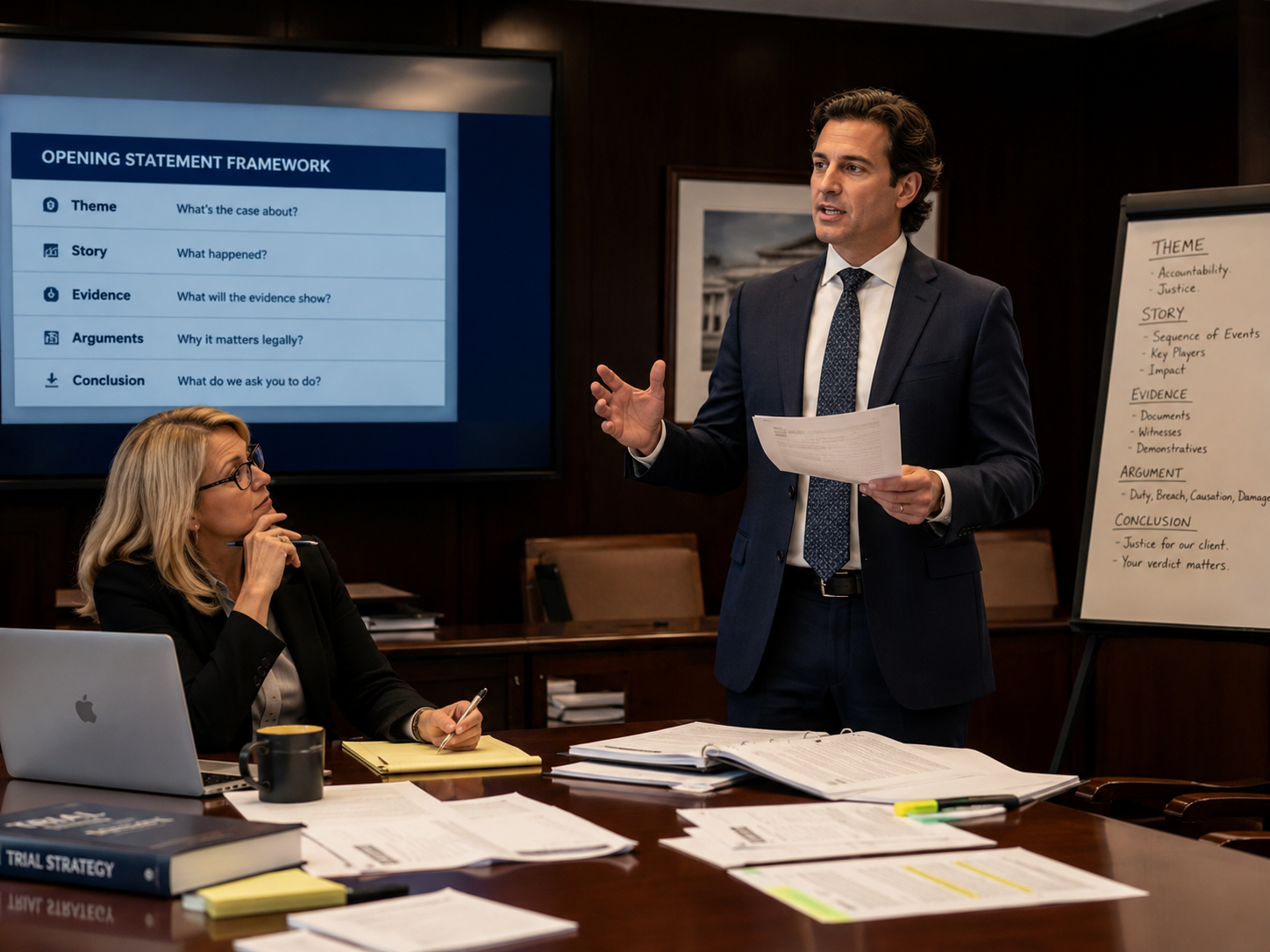

There are certain parts of a trial that lawyers instinctively believe they should do themselves.
Writing the opening statement is near the top of the list.
I understand why.
The first chair knows the case.
The first chair knows the witnesses.
The first chair has lived with the documents, depositions, expert reports, motions, bad facts, good facts, and opposing counsel—sometimes for years.
So when trial approaches, it seems perfectly natural for that lawyer to sit down and write the opening statement.
But I would ask a different question:
Does knowing the case better than anyone else necessarily make you the best person to decide how someone hearing the case for the first time should hear it?
Those are not quite the same skill.
In two recent articles, I argued that lawyers should generally stop designing their own PowerPoint slides and stop running their own courtroom technology.
My reasoning was not that lawyers are incapable of either task.
Of course they are capable.
My point was that highly specialized work should often be performed by people who specialize in it—particularly when millions or billions of dollars may be riding on the result.
I think the same principle applies to opening statements.
Trial lawyers should at least consider getting outside help drafting them.
Not because the trial lawyer should surrender control.
Quite the opposite.
The right collaboration can give the lawyer a clearer, simpler, more persuasive version of the case to make entirely his or her own.
Nobody Is Suggesting That Someone Else Should Give Your Opening
Let's dispose of the biggest objection immediately.
I am not suggesting that a consultant should write an opening statement, hand it to a trial lawyer the night before trial, and say:
“Here. Memorize this.”
That would be terrible.
The opening statement has to sound like the lawyer giving it.
The language has to feel natural.
The themes have to be believable coming from that particular advocate.
The lawyer has to understand why every section is there, where every transition is going, why certain facts are emphasized, why others are omitted, and how the opening fits into the larger trial strategy.
The lawyer must own it.
But owning an opening statement and drafting every sentence of it yourself are two entirely different things.
That distinction matters.
Great speeches are routinely collaborative.
Great books have editors.
Great CEOs have communications professionals.
Great filmmakers have screenwriters, editors, cinematographers, and producers.
The person delivering the message remains responsible for the message.
But sophisticated communicators understand that outside expertise can make the final product considerably better.
Why should a major trial be different?
I Have Been Doing This Collaboratively for Decades
In 21 Secrets From an Opening Statement Guru, I described how opening statement development has worked throughout much of my career.
Sometimes the first-chair lawyer does 80 percent of the drafting and I or others contribute 20 percent.
Sometimes those percentages are reversed.
Sometimes we begin with a nearly complete opening.
Sometimes we begin with thousands of pages of case materials and a conversation about what the case is really about.
But the process is almost always collaborative.
And I think that is precisely why it works.
The lawyer brings something the consultant cannot possibly replicate: intimate knowledge of the case, legal judgment, courtroom instincts, knowledge of the judge, relationships with the witnesses, and personal credibility.
An experienced litigation consultant brings something different: perspective.
That difference is enormously valuable.
You May Know Too Much About Your Case
One of the great paradoxes of trial preparation is that expertise can become an obstacle to communication.
You have lived with the case for three years.
The jury has not.
You know that “the March 14 email” matters because you have seen it 200 times.
The jurors have never heard of the sender.
You understand why Exhibit 437 changes the meaning of Exhibit 212.
The jurors do not yet know what either exhibit is.
You know which of the twelve disputed contract provisions actually matters.
The jury does not yet understand the contract.
This is the curse of knowledge in action.
Once we understand something deeply, it becomes surprisingly difficult to remember what it was like not to understand it.
That creates a dangerous tendency in opening statements.
Lawyers explain what matters to lawyers who already know the case.
They do not always explain what matters to people encountering the case for the first time.
An outsider can keep asking the questions the jury will silently ask:
Who is this person?
Why should I care?
Why are you telling me this?
What does this document prove?
What is this case actually about?
Who did something wrong?
What should have happened instead?
Why does this matter?
Those questions can feel almost insultingly basic after years of litigation.
They are not.
They are the questions on which persuasion depends.
Great Opening Statements Are Usually the Product of Subtraction
One of the most difficult things we do with trial teams is simplify.
Lawyers tend to believe that important facts deserve inclusion.
That sounds logical.
Unfortunately, there may be 600 important facts.
A jury cannot absorb 600 important facts in an opening statement.
So somebody has to decide what survives.
That is why I have repeatedly emphasized one principle in our opening-statement work:
Simplify. Simplify. Simplify.
The best trial lawyers I have worked with understand this instinctively.
They do not demonstrate mastery by telling jurors everything they know.
They demonstrate mastery by deciding what jurors actually need to know.
The opening statement is not the trial.
It is the framework through which the jury will understand the trial.
And frameworks work because they leave things out.
An experienced outside consultant has one tremendous advantage here:
We are less emotionally attached to the material.
We did not take the deposition.
We did not spend three weeks fighting over the document request.
We did not write the summary judgment brief.
We do not care that an issue was incredibly difficult to litigate.
We care whether it advances the story.
That makes subtraction easier.
Lawyers Often Confuse Chronology With Storytelling
There is another pattern I see repeatedly.
A lawyer knows the chronology exceptionally well.
So the opening becomes:
This happened.
And then this happened.
And then they sent this email.
And then there was a meeting.
And then the contract was amended.
And then somebody complained.
And then litigation began.
Everything may be completely accurate.
And completely forgettable.
As I recently wrote in The Simplest Storytelling Trick for Persuasion Might Have Come from South Park, one useful test is whether the major parts of the opening are connected primarily by “and then.”
If they are, you probably have a chronology.
Not yet a story.
Stories are built around conflict and consequence:
But.
Therefore.
The company promised X, but internally it knew Y.
Therefore, management faced a choice.
Management chose Z, but concealed what had happened.
Therefore, the consequences became unavoidable.
Now the facts have direction.
A skilled opening-statement consultant should be looking for exactly those connections.
Not simply:
“What happened next?”
But:
“Why did what happened next matter?”
That is where chronology begins turning into persuasion.
Your Opening Statement Should Be Written for Jurors, Not Lawyers
Lawyers are trained to qualify.
To distinguish.
To hedge.
To anticipate exceptions.
To define.
To footnote.
To preserve arguments.
These are enormously valuable legal skills.
They can produce terrible oral communication.
A brief might say:
“The evidence is expected to demonstrate that, notwithstanding Defendant's representations concerning its compliance program, senior management possessed contemporaneous information tending to establish that certain procedures had not been implemented consistently across all relevant operating units.”
That may survive partner review.
Nobody talks that way.
Especially not to jurors.
An opening statement might instead say:
“They told everyone the safety system was working. Their own documents show they knew it wasn't.”
Same case.
Different communication.
Outside drafting support can be particularly valuable because somebody has permission to say:
I know that sentence is legally precise.
But nobody will remember it.
Let's say what you actually mean.
The Economics May Make Sense Too
There is a strange assumption inside some law firms that drafting an opening internally is free.
It isn't.
Suppose a partner and several associates spend dozens or even hundreds of hours drafting, reorganizing, rewriting, editing, and building the opening.
Those are extremely expensive hours.
More importantly, they are finite hours.
Every hour spent rewriting the fourth version of the introductory chronology is an hour that cannot be spent preparing the CEO.
Or refining cross-examination.
Or anticipating evidentiary disputes.
Or preparing for the judge's likely questions.
Or learning the weaknesses in the opponent's expert testimony.
This is essentially the same economic argument I made when discussing lawyers designing PowerPoint presentations.
The question is not:
Can the lawyer do this?
The lawyer almost certainly can.
The better question is:
Is this the highest-value use of that lawyer's time, and will doing it entirely in-house produce the best result?
Sometimes the answer will be yes.
Frequently, I think the answer is no.
Outside Drafting Creates Something Every Trial Team Needs: A Fresh Set of Eyes
There is another reason I like involving someone who has not lived with the case.
Surprise.
After thousands of hours of discovery, the trial team stops being surprised by the case.
That is dangerous.
Jurors are going to be surprised by it.
An outsider may read one email and say:
“Wait. He knew about this before the meeting?”
Everybody on the trial team responds:
“Yes, of course.”
Stop.
That reaction matters.
The outsider just experienced something much closer to what a juror may experience.
That moment may belong in the opening.
Or an outsider may ask:
“Why didn't your client just terminate the agreement?”
Everyone around the conference table knows the answer.
Wonderful.
The jury won't.
Put the answer in the opening.
Fresh eyes expose assumptions.
Assumptions left unexplained become openings for opposing counsel.
Outsourcing Also Makes Testing Easier
I do not believe important opening statements should emerge fully formed three days before trial.
They should evolve.
Draft.
Present.
Cut.
Reorganize.
Test.
Rewrite.
Rehearse.
And, when the stakes justify it, test the competing stories with mock jurors.
We have written previously about using mock trials to develop opening statements because mock jurors often reveal something the trial team simply cannot see from inside the case.
The theme everyone loves may fall flat.
The fact everyone thought was devastating may barely register.
A supposedly minor bad fact may dominate deliberations.
The explanation that seems obvious may confuse everyone.
Or a phrase someone almost deleted becomes the language mock jurors repeat to one another during deliberations.
That feedback is gold.
And it reinforces a larger point:
An opening statement should be developed, not merely written.
AI Makes This Argument More Important, Not Less
There is an obvious new player in opening-statement drafting.
Artificial intelligence.
AI can summarize testimony.
It can reorganize facts.
It can propose themes.
It can produce twenty different introductions before lunch.
Those capabilities are useful.
But generating language is not the same thing as developing a persuasion strategy.
AI does not sit behind a one-way mirror watching a mock jury misunderstand your favorite argument.
It does not notice the subtle expression on a juror's face when your client is described a certain way.
It does not have decades of accumulated courtroom experience watching which lawyers connect and which lawyers lose the room.
And most importantly, AI does not know which version sounds authentically like you unless a human trial team shapes it carefully.
I expect AI to become an increasingly valuable tool in opening-statement development.
But I see it as another tool.
Not the strategist.
The Trial Lawyer Should Still Be the Author in the Most Important Sense
By the time opening statement begins, something interesting should have happened.
The consultant's words should have disappeared.
So should the associate's words.
So should the partner's edits.
There should only be the lawyer and the story.
The lawyer should know where it is going.
The lawyer should understand why each piece is there.
The lawyer should be able to depart from the exact wording without losing the structure.
The lawyer should be able to look at the jury instead of reading.
The opening should feel so natural that nobody could identify which sentence originated with whom.
That is successful collaboration.
The goal of outsourcing opening-statement drafting is not to make the lawyer less important.
It is to free the lawyer to concentrate on the part nobody else can outsource:
Being the advocate.
Lawyers Should Not Have to Do Everything Themselves
There is a larger theme running through these last several articles.
Trial lawyers do extraordinarily difficult work.
Their highest-value contribution is judgment.
Strategy.
Examination.
Credibility.
Connection.
Persuasion.
They do not also need to be graphic designers.
They do not also need to be courtroom technicians.
And they do not necessarily need to stare at a blank Microsoft Word document and personally manufacture every sentence of an opening statement from scratch.
Sometimes the best thing a trial lawyer can do is bring specialists into the room.
Let the graphic designer help visualize the case.
Let the trial technician run the technology.
Let experienced persuasion and storytelling professionals help develop the opening.
Then rehearse it.
Challenge it.
Rewrite it.
Test it.
Make it yours.
And when the judge turns to you and says:
“Counsel, you may proceed.”
Stand up.
Look at the jury.
And tell them the story.
Related Persuadius Articles & Resources
- 21 Secrets From an Opening Statement Guru — Draws on decades of opening-statement work to identify 21 practical principles for simplifying the case, telling a compelling story, using visuals effectively, practicing extensively, and collaborating with trial consultants. Read 21 Secrets From an Opening Statement Guru
- Why Lawyers Should Stop Designing Their Own PowerPoint Slides — Makes the case that effective courtroom visual communication is a specialized discipline and that trial lawyers should spend their limited preparation time on advocacy rather than trying to become graphic designers. Read Why Lawyers Should Stop Designing Their Own PowerPoint Slides
- Why Attorneys Should Not Run Their Own Trial Technology — Explains why operating courtroom technology divides a trial lawyer’s attention at precisely the moment it should be concentrated on witnesses, jurors, strategy, and persuasion. Read Why Attorneys Should Not Run Their Own Trial Technology
- Simplifying Your Opening Statement to Its Core — Argues that great trial lawyers distinguish themselves not by telling jurors everything they know, but by stripping complicated cases down to a simple, memorable story jurors can understand and repeat during deliberations. Read Simplifying Your Opening Statement to Its Core
- The Simplest Storytelling Trick for Persuasion Might Have Come from South Park — Uses the “And-But-Therefore” storytelling test to show how trial lawyers can transform a sequence of facts from a mere chronology into a story driven by conflict, causation, and consequence. Read The Simplest Storytelling Trick for Persuasion
- Persuasive Storytelling in Trial: Why a Narrative Opening Beats a Chronological Statement — Demonstrates why jurors are more likely to understand, remember, and retell a case presented as a coherent human story than one presented merely as a succession of dates, documents, and events. Read Persuasive Storytelling in Trial
- 5 Reasons You Should Use a Mock Trial to Develop Your Opening Statement — Shows how mock trials allow lawyers to test competing approaches, themes, evidence, delivery, and juror reactions before committing to the opening they will actually use at trial. Read 5 Reasons You Should Use a Mock Trial to Develop Your Opening Statement
- 7 Ways to Draft a Better Opening Statement — Offers seven practical approaches to developing an opening statement deliberately rather than simply sitting down in front of a blank Word document and beginning to write. Read 7 Ways to Draft a Better Opening Statement
- The Opening Statement Toolkit — Persuadius’s free 271-page e-book collects 80 articles on opening statements, storytelling, persuasion, trial graphics, jury psychology, and related techniques into a single comprehensive resource for litigators. Get The Opening Statement Toolkit
Need Help With an Opening Statement?
Persuadius works collaboratively with trial teams to develop, draft, rewrite, test, and refine opening statements for high-stakes litigation.
We can begin with your existing draft, an outline, or the case materials themselves. The objective is not to replace the trial lawyer's voice. It is to help make that voice as clear, credible, memorable, and persuasive as possible.
Schedule a free 15-minute case consultation to discuss your opening statement and trial strategy.
Or, if confidentiality and conflicts are your first concern, submit a confidential conflict check before sharing case details.


Leave a Comment