


You might be waking up today to a world that looks like it’s been quietly buried in snow. Sidewalks vanish. Cars turn into white shapes. The usual landmarks of daily life—curbs, steps, driveways—are suddenly indistinct.
Or you might be waking up somewhere warm, watching the rest of the country post photos of it.
Either way, it’s a useful metaphor for what happens to litigators in the weeks leading up to trial: you look up one morning and realize you’re buried too—only this time it’s not snow.
It’s evidence.
Every Litigator Eventually Meets the Monster
Every litigator eventually runs into a problem that has nothing to do with the law.
It isn’t opposing counsel.
It isn’t the judge.
It isn’t even the facts.
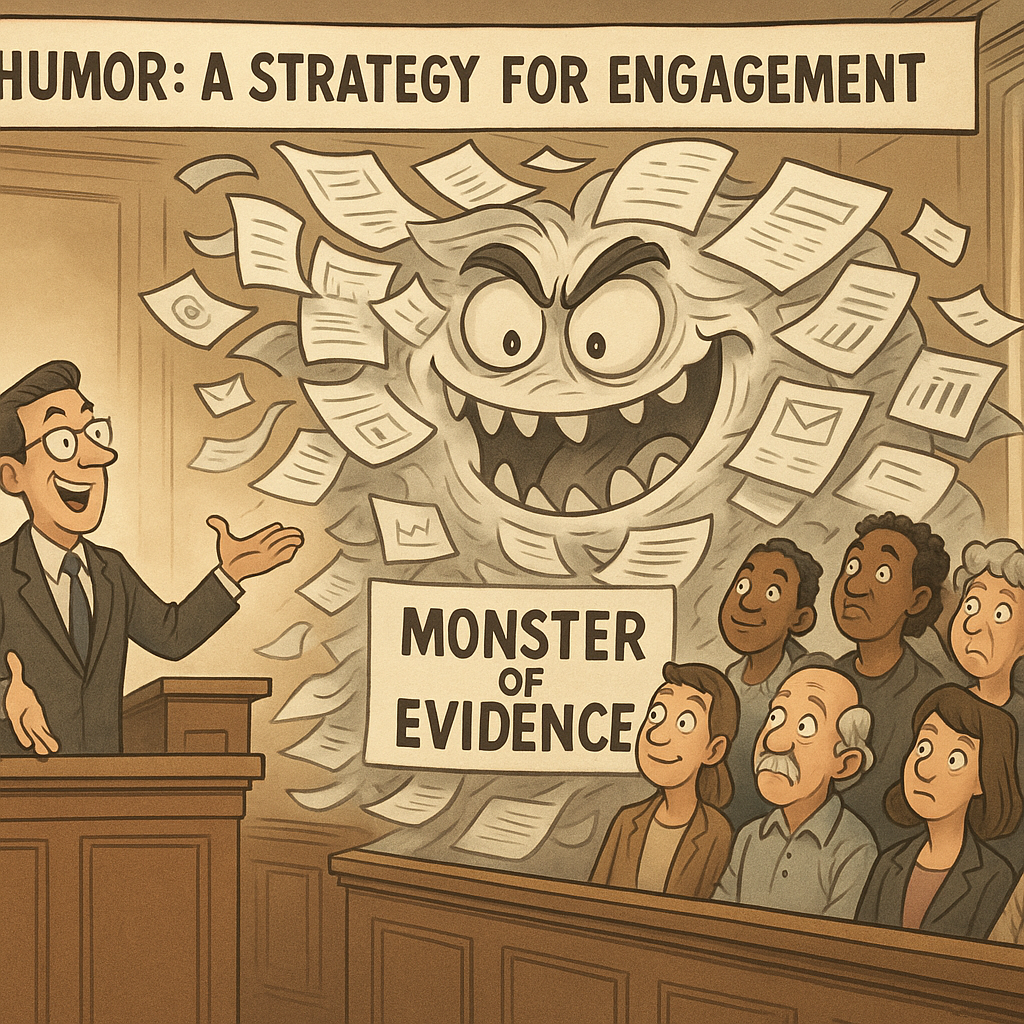
It’s the creeping, suffocating sense that your case has turned into a monster of evidence.
Not because you don’t have enough.
Because you have too much.
Too many exhibits. Too many emails. Too many timelines. Too many deposition clips. Too many charts. Too many “just one more thing” moments.
And there’s always a reason for adding one more:
-
This document proves intent.
-
This email shows knowledge.
-
This timeline entry explains context.
-
This screenshot will finally make it click.
And maybe each one does.
But there’s a cost to feeding the monster.
The monster doesn’t kill your case by being wrong.
It kills your case by being boring.
The Real Risk Isn’t Lack of Evidence — It’s Mental Fatigue
Jurors don’t come to trial hoping to be bored. They don’t want to drift.
But drift happens anyway.
It happens when everything starts sounding the same.
Exhibit 14 feels like Exhibit 114.
One more email thread becomes one more sedative.
One more chart becomes one more math assignment.
And then something subtle changes:
The jury stops actively listening… and starts passively waiting.
That’s where persuasion goes to die.
And it’s also where bias starts to harden.
Because when jurors stop processing actively, they don’t become “neutral.” They become efficient. They start filtering what they hear through whatever story they’ve already started believing. This is why cognitive bias is such a courtroom problem: jurors aren’t being difficult—they’re being human. You explored that beautifully in The Impact of Cognitive Bias on Jury Interpretation and Persuasion.
A Quick Aside: Demonstrative Evidence Is Already Half a Joke
I’ve always loved that the phrase “demonstrative evidence” sounds like something invented by someone who has never tried a case.
It’s a sterile label for something that—at its best—is vivid, memorable, and alive.
And yes, I’ve used the pun “de-monstrative evidence” before (see here), because the truth is: some exhibits don’t demonstrate anything.
They just monstrate.
They lumber into the courtroom like a creature made of bullet points and regret, consuming oxygen and attention until the entire case feels like a PowerPoint hostage situation.
Which is another way of saying: not all evidence is persuasive simply because it exists.
Humor Isn’t Decoration. It’s a Pressure-Release Valve.
Let’s be clear about what this article is not advocating.
I’m not suggesting you become a comedian in front of a jury.
Most lawyers shouldn’t.
And even lawyers who are naturally funny often become less funny when they try to “do humor.”
The goal is not laughter.
The goal is relief.
Humor, used correctly, is a pressure-release valve that keeps the jury engaged long enough to absorb what actually matters.
It’s a moment that says:
“I know this is a lot. I’m still with you. Stay with me.”
That’s not entertainment.
That’s strategy.
And it fits perfectly into the broader challenge of managing juror bias, because bias is often less about ideology and more about mental shortcuts. Jurors simplify. They conserve energy. They accept the story that feels coherent and resist the story that feels complicated. If you don’t help them stay mentally present, bias does the simplifying for them. (More here: Managing Juror Bias.)
Humor Creates Contrast — and Contrast Creates Memory
There’s a reason humor works when it works.
It creates contrast.
It changes the rhythm of the presentation.
It wakes people up.
It helps jurors remember what happened before and after the moment of relief.
Which brings us back to confirmation bias.
Jurors don’t accept information evenly. They accept what fits their developing story and resist what doesn’t.
So the challenge isn’t just dumping more evidence onto them.
The challenge is interrupting autopilot.
One of the best ways to interrupt autopilot is to create something memorable.
Sometimes that’s surprise. Sometimes it’s scale. Sometimes it’s narrative timing.
And sometimes—carefully—it’s humor.
If you want the cleanest Persuadius explanation of this principle, you already wrote it: Could Surprise Be One of Your Best Visual Persuasion Tools?.
Because surprise (like humor) forces jurors to do something they weren’t planning to do:
pay attention again.
What Humor Does in Trial (When It’s Done Right)
When humor works, it tends to do four things:
1) It restores attention
Jurors re-engage when the pattern breaks.
2) It makes the next exhibit stick
Humor acts like a highlighter for memory.
3) It humanizes the lawyer
Not by making you “likable,” but by making you feel grounded and real.
4) It reduces the monster’s power
Because monotony is the monster’s fuel.
The Best Courtroom Humor Is Quiet
The safest humor isn’t a joke.
It’s an acknowledgement.
It’s a line that makes jurors think, Yes. Exactly.
Examples of the type (not a script):
-
“This is not the world’s greatest email thread… but it’s an honest one.”
-
“You don’t have to love spreadsheets to understand what happened here.”
-
“I promise this is the last time I’m going to say the phrase ‘metadata’ today.”
That’s not comedy.
That’s permission to keep going.
And it’s also a subtle way of keeping jurors from retreating into bias-driven simplification. In other words: you’re not being cute—you’re preventing the jury from checking out.
The Monster of Evidence Always Tries to Trick You
Here’s the monster’s favorite trick:
It convinces you that the solution to a persuasion problem is… more evidence.
More slides.
More callouts.
More charts.
More quotes.
More clips.
It feels responsible.
It feels thorough.
It feels safe.
But jurors don’t reward thoroughness the way lawyers do.
They reward clarity.
They reward meaning.
They reward the feeling that you are guiding them rather than burying them.
A small moment of humor can keep your audience receptive—but only if you’ve earned it, and only if it’s attached to a point that matters.
The Goal Isn’t to Make Them Laugh. It’s to Keep Them Listening.
Humor is not a substitute for proof.
It’s not a shortcut.
It’s not charm school.
It’s simply a way to keep the jury receptive when the monster of evidence is trying to grind the trial into sameness.
Used carefully, humor buys you something priceless:
A few more minutes of attention.
A few more inches of mental space.
A jury that stays human long enough to understand what matters.
And in a long trial, that is often the difference between “we proved it” and “we won.”
If You Want Help Turning Evidence Into Something Jurors Remember
If you’re heading toward trial and you feel the monster forming—too much evidence, too little time, too many moving parts—Persuadius can help.
We support trial teams with:
-
litigation graphics and demonstratives
-
trial presentation strategy
-
trial technician / hot-seat support
-
jury consulting and research
-
opening statement support
If you want to talk through a case, schedule a quick call here:
https://calendly.com/kenlopez/15-minute-case-consultation
or
Send a CONFIDENTIAL email to confidential@persuadius.com.
Additional Reading (Persuadius)
-
The Impact of Cognitive Bias on Jury Interpretation and Persuasion
-
Font Matters: A Trial Graphics Consultant’s Trick to Overcome Bias


Leave a Comment