

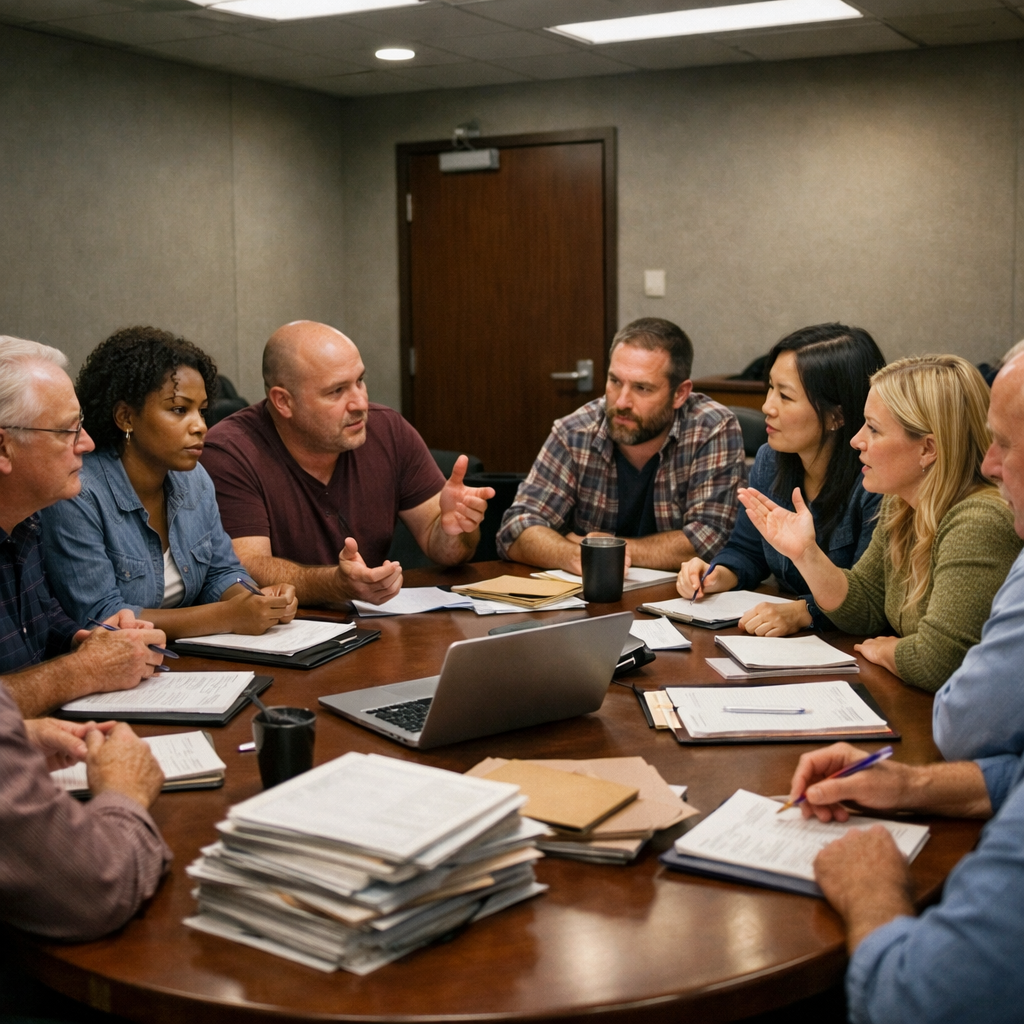

Trials are not won when counsel sits down. They are won later, when twelve jurors sit around a table trying to persuade one another.
That reality changes how trial teams should think about persuasion. The real question is not:
“Did we present a compelling case?”
It’s:
“Did we give jurors arguments they can actually use?”
Because once deliberations begin, lawyers disappear. The courtroom disappears. What remains are jurors debating facts, credibility, responsibility, and damages. Jurors become the advocates.
And the side that wins is often the side whose arguments are easiest to remember, explain, and repeat.
At Persuadius, this principle shows up across all of our services—jury consulting, storytelling and opening statement development, litigation graphics, and courtroom presentation. Each discipline contributes to a single goal:
Equipping jurors with persuasive tools they can carry into the jury room.
Jurors Become Advocates in Deliberations
Deliberations are essentially a second trial—without lawyers present.
Jurors:
-
summarize evidence,
-
debate credibility,
-
argue about responsibility,
-
and try to persuade one another.
In nearly every jury room, a few jurors become leaders. Others follow. Some persuade logically, others emotionally, and others pragmatically.
Winning trial teams help their jurors succeed in that role.
That means giving them:
-
simple logic chains,
-
and documentary proof.
If a juror can only say, “I just feel they’re responsible,” that argument dies quickly.
If a juror can say, “Look at the timeline—they knew about the problem two years earlier and still did nothing,” now persuasion begins.
The difference is preparation.
Storytelling: The Most Powerful Deliberation Tool
Storytelling may be the most important way to give jurors arguments they can use later.
Jurors do not deliberate using isolated facts. They deliberate using stories.
Stories answer:
-
What happened?
-
Why did it happen?
-
Who made decisions?
-
Who could have prevented harm?
-
Who must take responsibility?
When jurors persuade one another, they don’t recite evidence lists. They retell narratives:
“First they discovered the defect. Then management decided not to fix it. Then the failure occurred.”
A strong trial story allows jurors to become storytellers themselves.
Persuasive storytelling techniques help jurors:
-
organize facts,
-
remember sequences,
-
understand motivations,
-
and explain responsibility.
And importantly, stories are portable. Jurors carry them into deliberations and repeat them naturally.
At Persuadius, our opening statement and storytelling work focuses on giving jurors a narrative framework they can easily retell when the real persuasion begins.
Free Book Download: The Opening Statement Handbook or Storytelling for Persuasion
Jury Research: Finding Jurors Who Can Persuade Others
Jury consulting isn’t only about identifying favorable jurors—it’s about understanding who influences others.
Mock trials consistently show:
-
certain jurors dominate discussion,
-
some organize evidence,
-
some naturally lead,
-
and others simply follow confident speakers.
In jury research, we watch closely:
-
Who persuades others?
-
Who explains evidence clearly?
-
Who withstands pressure?
-
Who reframes arguments?
These jurors often drive verdict outcomes.
Effective jury selection seeks jurors who not only lean toward your case, but who can articulate and defend it.
The goal is simple:
Seat jurors who can argue your case after you leave the room.
Research also reveals which arguments survive deliberations—and which collapse under scrutiny.
Learn more about our Jury Consulting Services.
Litigation Graphics: Making Arguments Easy to Repeat
Graphics are not decoration. They are memory tools.
Jurors often remember visuals more clearly than testimony. A good graphic becomes shorthand for an entire argument.
Deliberations require jurors to reconstruct:
-
timelines,
-
decision points,
-
responsibility chains,
-
causation,
-
and damages.
Well-designed visuals help jurors rebuild arguments:
“Here’s when they learned about the problem.”
“Here’s the step they skipped.”
“Here’s how the failure happened.”
Jurors frequently redraw visuals on notepads during deliberations. Graphics that are simple, clear, and logical travel into the jury room.
At Persuadius, our trial graphics teams focus on visuals jurors can remember—and explain.
Download our Free Opening Statement Toolkit or Litigation Graphics Guide for Trial lawyers
Trial Technicians: Putting Proof in Jurors’ Hands
Jurors trust documents more than arguments.
Arguments feel like advocacy. Documents feel like reality.
Clear courtroom presentation ensures jurors actually absorb the evidence they later rely on.
Effective presentation includes:
-
highlighting key language,
-
juxtaposing contradictory documents,
-
pairing testimony with exhibits,
-
zooming into decisive text,
-
and repeating critical proof.
The goal is not just showing evidence—it is making evidence memorable.
Winning jurors say:
-
“It’s in the email.”
-
“Look at the memo.”
-
“They admitted it.”
Persuadius trial technicians ensure that jurors clearly see and remember documentary proof.
Download the Persuadius Guide to Finding and Hiring a Trial Technician or Ask Persuadius for a Confidential Conflicts Check
Building Deliberation-Ready Arguments
How can trial teams deliberately prepare arguments jurors can use?
1. Simplify Logic Chains
Jurors need arguments explainable in seconds.
Better:
“They knew. They ignored it. Someone got hurt.”
or
"Her cancer could have come from pumping gas, the dry cleaning, risky sexual practices, or drinking."
Complex reasoning rarely survives deliberations.
2. Use Repeatable Language
Jurors repeat phrases that stick:
-
“Safety was optional to them.”
-
“They chose speed over safety.”
-
“They gambled with their own lives.”
-
"This accident would have happened anyway."
Memorable language travels.
3. Tie Arguments to Evidence
Jurors persuade best when pointing to proof:
-
“Remember Exhibit 25.”
-
“The email says…”
-
“The timeline proves it.”
Proof wins debates.
4. Create Visual Anchors
Ask:
-
Can jurors redraw this?
-
Can they explain it?
If yes, the graphic works.
5. Repeat Key Proof Moments
Jurors forget what they see once. They remember what they see repeatedly.
Repetition builds deliberation tools.
The Jury Room Is Where Cases Are Won
Persuasion does not end with closing argument.
The real persuasion begins when jurors debate responsibility, credibility, and proof.
Winning trial teams ask:
-
What arguments will jurors use?
-
What proof will they cite?
-
What visuals will they remember?
-
Which jurors will lead?
The case that survives deliberation wins.
And survival depends on how well jurors can carry your arguments with them.
How Persuadius Helps Trial Teams Equip Jurors to Persuade
Persuadius supports trial teams nationwide through:
-
Jury consulting and research
-
Opening statement and storytelling development
-
Litigation and trial graphics
-
Courtroom presentation and trial technicians
Whether preparing months in advance or stepping in shortly before trial, our teams help ensure jurors understand—and can later argue—your case.
👉 Book a free 15-minute case consultation with a Persuadius litigation consultant
https://calendly.com/kenlopez/15-minute-case-consultation
👉 Request a free conflicts check
https://persuadius.com/persuadius-conflicts-check-litigation-graphics-trial-technician-mock-trial-jury-consultants
👉 Send us a confidential email about your matter:
confidential@persuadius.com
Related Persuadius Articles
You may also enjoy:
-
• Persuasion Pairing: Cleverly Combining Words and Pictures
https://persuadius.com/blog/persuasion-pairing-cleverly-combining-words-and-pictures -
• What a Boeing Storyteller Taught Me About Litigation Graphics
https://persuadius.com/blog/what-a-boeing-storyteller-taught-me-about-litigation-graphics -
• 10 Essential Legal Storytelling Techniques for Every Litigator
https://persuadius.com/blog/10-essential-legal-storytelling-techniques-for-every-litigator -
• Storytelling for Litigators (E-book)
https://persuadius.com/storytelling-for-litigators-edition-ebook-5th -
• Ten Ways to Maximize Persuasive Courtroom Storytelling
https://persuadius.com/blog/ten-ways-to-maximize-persuasive-courtroom-storytelling-part-one

Leave a Comment