

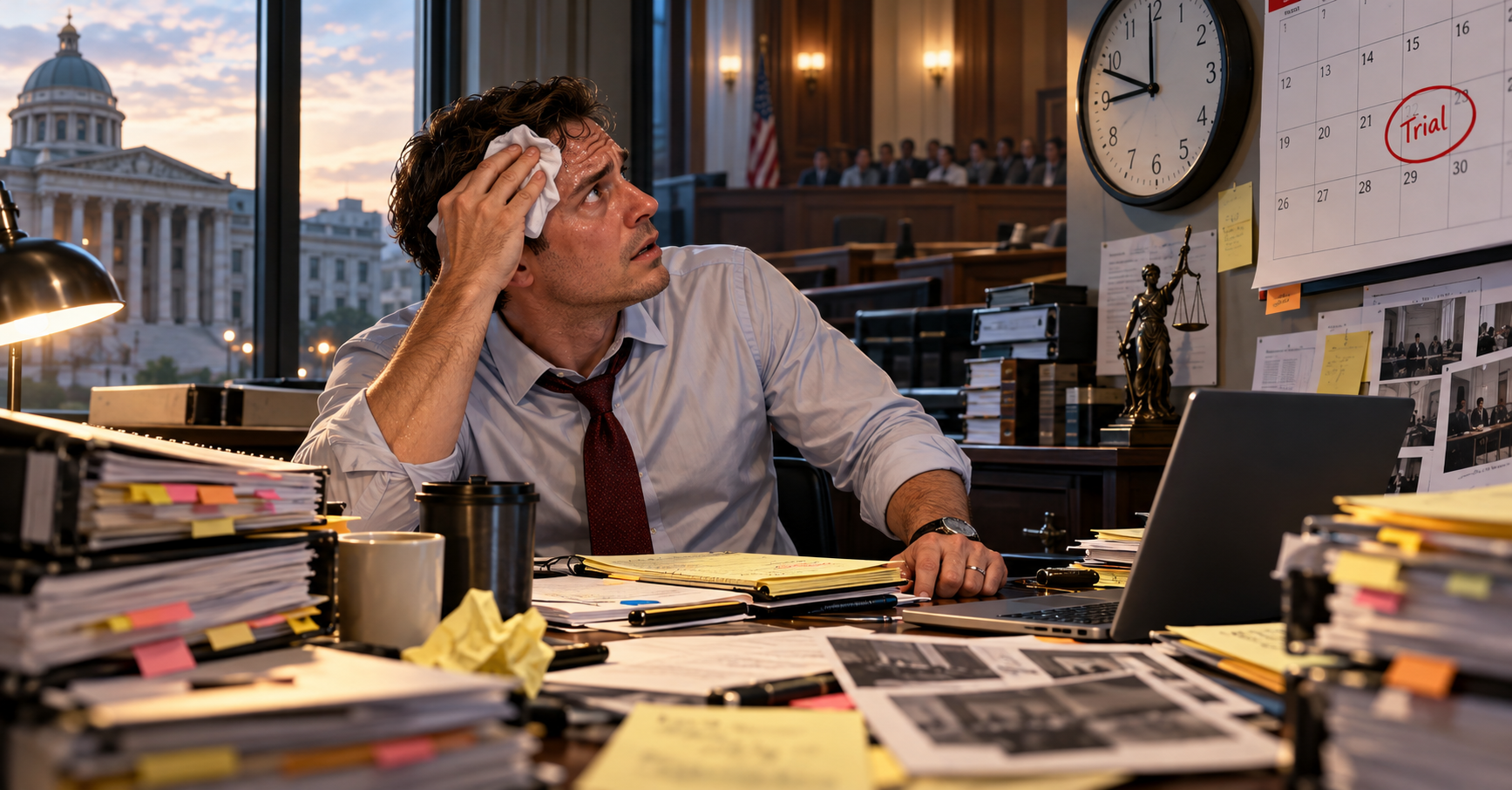

The difference between preparing a case and preparing to win it may be the most expensive distinction in litigation.
Imagine this scenario.
A litigation team has spent three years preparing a complex commercial case. They've reviewed two million documents, taken 47 depositions, retained six experts, filed countless motions, and billed thousands of hours.
They know the facts. They know the law. They know the opposing counsel's arguments almost as well as their own.
Trial begins in three weeks.
And someone finally asks:
"What's our story?"
Silence.
Then another question: "Have we tested any of this with jurors?"
More silence.
"Who's putting together the opening statement graphics?"
"We're working on that."
"Have we hired a trial technician?"
"Not yet."
Sound familiar?
After nearly three decades working with trial teams, I've seen variations of this scenario more times than I care to count.
And here's the uncomfortable truth: Some of the hardest-working lawyers in America are among the least prepared for the part of litigation that actually happens in front of a jury.
Not because they're lazy. Not because they're incompetent. And certainly not because they don't care.
It's because preparing a case and preparing to persuade a jury are two very different things.
Unfortunately, the distinction often becomes apparent when there's almost no time left to do anything about it.
1. Discovery Is Not Trial Preparation
Let's start with a fundamental misunderstanding.
Discovery is about finding and understanding evidence. Trial preparation is about deciding what that evidence means, how to organize it, and how to make twelve strangers care about it.
These are related activities, but they require different skills.
You can spend three years becoming the world's leading expert on the facts of your case and still struggle to explain those facts to someone who has never heard of your client, your industry, or the underlying dispute.
In fact, your expertise can become a liability.
The more you know about a case, the harder it can be to recognize which details matter to someone encountering it for the first time.
Psychologists call one aspect of this problem the curse of knowledge. Once we know something, it becomes difficult to imagine not knowing it.
Trial lawyers are particularly vulnerable because they spend years immersed in information that jurors must begin absorbing in a matter of hours.
The question isn't whether you understand your case. It's whether the jury will.
And that question should be driving your preparation long before the trial date appears on the horizon.
2. Your Trial Story Shouldn't Be the Last Thing You Develop
Here's a question I like to ask trial teams:
"If you had to explain why your client should win in one sentence, what would you say?"
Sometimes I get a crisp, memorable answer.
Other times, I get a fifteen-minute explanation involving procedural history, contractual provisions, industry terminology, and three exceptions to the general rule.
That's not a story. That's a deposition outline.
Every compelling trial presentation needs a central narrative that helps jurors organize the evidence and understand why it matters.
That narrative shouldn't emerge accidentally during the weekend before opening statements.
It should influence which witnesses you emphasize, which exhibits you feature, which demonstratives you develop, and how you prepare your experts.
Without it, trial preparation becomes an exercise in assembling information rather than communicating meaning.
And the closer you get to trial, the harder it becomes to change direction.
3. You Discover Your Case's Biggest Weakness When It's Too Late to Fix It
One of the most valuable things a mock trial can reveal is something the trial team never seriously considered.
Perhaps jurors don't trust your key witness.
Perhaps they misunderstand a technical issue.
Perhaps an argument the lawyers consider devastating barely registers with ordinary people.
Or perhaps the defense that has consumed hundreds of attorney hours actually makes jurors more suspicious of your client.
These discoveries are useful when there's time to respond.
They're considerably less useful when opening statements begin Monday morning.
Mock trials and focus groups aren't simply opportunities to predict what a jury might do. They're opportunities to identify persuasion problems while you still have time to address them.
A well-designed jury research exercise can influence the trial story, witness preparation, opening statement, graphics, and even settlement discussions.
But only if the trial team acts on what it learns.
The value of jury research isn't just discovering what jurors think. It's having enough time to do something about it.
4. Your Opening Statement Becomes a Summary Instead of a Story
When lawyers begin preparing their opening statements too late, there's a predictable temptation.
They start organizing evidence.
First this happened. Then that happened. Then this witness will testify. Then we'll show you this document.
It's chronological. It's thorough. It's legally defensible.
And it may be painfully forgettable.
An effective opening statement does more than preview evidence. It gives jurors a framework for interpreting everything that follows.
It identifies the central conflict, establishes the stakes, and provides a coherent explanation of why the evidence matters.
That requires more than writing.
It requires editing, testing, rehearsing, and sometimes throwing away an approach that initially seemed brilliant.
Those are difficult things to do when the opening statement is still being assembled at midnight before trial.
The best time to discover that your opening doesn't work is not when twelve jurors are watching you deliver it.
5. Your Trial Graphics Become Decoration Instead of Persuasion
This is one of the most common and avoidable consequences of late preparation.
A lawyer calls a litigation graphics consultant and says:
"We need some slides for opening. Trial starts next week."
The consultant asks what the slides should accomplish.
"Well, we have about 150 pages of material we'd like you to turn into PowerPoint."
That's not a graphics strategy.
That's a production assignment.
Good trial graphics aren't merely attractive representations of information. They're tools for helping jurors understand, organize, remember, and sometimes reconsider complicated evidence.
A well-conceived graphic can simplify a technical process, expose a contradiction, establish a timeline, or make an otherwise abstract relationship immediately understandable.
But the most effective graphics often require collaboration, iteration, and careful consideration of the case narrative.
When the assignment arrives at the last minute, there may be time to make the slides look better.
There may not be time to rethink what the slides should be communicating.
The difference between making slides and developing visual persuasion can be enormous.
6. Your Experts Know Everything Except How to Explain It
Expert witnesses can spend years developing extraordinary technical expertise.
Unfortunately, that doesn't necessarily make them effective teachers.
An expert who can explain a complex financial model to another economist may have difficulty explaining the same concept to a juror who hasn't taken a mathematics class in twenty years.
The solution isn't simply telling the expert to use smaller words.
It's identifying the essential concepts, developing accessible analogies, anticipating confusion, and rehearsing explanations until they become clear without becoming misleading.
Sometimes that requires visual demonstratives. Sometimes it requires restructuring the testimony. Sometimes it means eliminating fascinating but unnecessary detail.
And sometimes it requires telling an exceptionally accomplished expert something they don't particularly want to hear:
"You're losing the audience."
Those conversations are much easier to have several weeks before trial than several hours before testimony.
7. You Run Out of Time to Simplify
There's a famous observation often attributed to Blaise Pascal: if he'd had more time, he would have written a shorter letter.
Trial preparation has the same problem.
When lawyers are rushed, they tend to include more.
More slides. More exhibits. More explanations. More qualifications. More background.
It's understandable. Eliminating information requires judgment, and judgment takes time.
But jurors don't reward lawyers for presenting the greatest possible quantity of evidence.
They need to understand the evidence that matters.
The process of simplifying a complex case may be among the most intellectually demanding parts of trial preparation.
It requires the confidence to distinguish between information that's important to the legal team and information that's important to the jury.
When time runs out, that distinction often disappears.
And the jury pays the price in cognitive overload.
8. Your Trial Technology Becomes an Unnecessary Source of Anxiety
A trial technician shouldn't first encounter your exhibit database on the morning of opening statements.
Neither should your lead attorney.
Effective courtroom technology requires organization, preparation, testing, and familiarity with the presentation system.
Exhibits need to be properly labeled. Video depositions need to be edited and checked. Demonstratives need to be organized. Equipment needs to be tested. Backup plans need to exist.
And the trial team needs to know how everything will work together.
The goal is for technology to become almost invisible.
Jurors should be concentrating on the evidence, not watching lawyers struggle to find an exhibit or wondering why a video won't play.
The best trial technology support makes the presentation look effortless.
But that apparent effortlessness usually requires considerable preparation.
9. You Lose the Opportunity to Rehearse
Musicians rehearse.
Actors rehearse.
Professional athletes practice relentlessly.
Yet some trial lawyers approach a multimillion-dollar jury trial having never delivered their opening statement aloud from beginning to end.
They've written it. They've edited it. They've thought about it.
But they haven't actually performed it.
And speaking an opening statement is different from reading one.
A sentence that looks elegant on paper may sound unnatural aloud. A transition that seems obvious in a written outline may confuse listeners. A visual that appears perfectly timed may interrupt the speaker's rhythm.
Rehearsal exposes these problems.
It also allows the trial team to evaluate pacing, clarity, movement, transitions, and the relationship between spoken words and visual evidence.
When preparation is compressed into the final few days, rehearsal is often one of the first things sacrificed.
That is a mistake.
10. You Start Making Expensive Decisions Under Pressure
Last-minute trial preparation doesn't necessarily save money.
It can create entirely new categories of expense.
Rush production. Overtime. Emergency travel. Duplicative work. Last-minute changes. Consultants who must rearrange other commitments.
More importantly, compressed schedules reduce the opportunity to make thoughtful decisions.
A graphic that could have been revised several times must be approved immediately.
A witness preparation session that should have taken place over multiple days becomes a single hurried meeting.
A trial strategy that should have been tested is adopted because there's no longer time to explore alternatives.
The cost isn't just financial.
It's the loss of flexibility.
And flexibility is particularly valuable when preparing for something as unpredictable as a jury trial.
11. Your Trial Team Never Becomes a Team
A trial involves more than lawyers.
Depending on the case, it may require jury consultants, litigation graphics specialists, trial technicians, expert witnesses, paralegals, and client representatives.
These people shouldn't be operating as independent departments that meet for the first time during trial.
They should be working toward a shared understanding of the case.
The jury research should inform the opening statement.
The opening statement should inform the graphics.
The graphics should support the witnesses.
The trial technician should understand the presentation strategy.
And the entire team should be prepared to adapt as the trial unfolds.
When everyone is brought together at the last minute, coordination becomes another emergency.
The individual components may be excellent.
But the presentation may still feel disjointed.
12. You Confuse Being Busy With Being Ready
This may be the most dangerous mistake of all.
In the weeks before trial, litigation teams are extraordinarily busy.
Everyone is working late. Emails are flying. Documents are being revised. Conference rooms are full. Meals arrive in cardboard containers.
The atmosphere is intense.
And that intensity can create a comforting illusion: because everyone is working so hard, the team must be getting ready.
But activity isn't the same as progress.
A team can spend an entire weekend perfecting a demonstrative that doesn't advance its central argument.
It can devote hours to a minor evidentiary dispute while neglecting a critical witness.
It can refine the wording of an opening statement without ever asking whether the story is persuasive.
The question isn't how many hours the team is working.
It's whether those hours are making the case more understandable, more credible, and more compelling to the people who will decide it.
What If Your Trial Is Already 30 Days Away?
At this point, some readers are probably thinking:
"This is all very interesting, but my trial starts next month. What am I supposed to do now?"
The answer is not to panic.
It's to prioritize.
Even with a compressed schedule, meaningful improvements may still be possible.
If you have 30 days:
You may still have time to conduct focused jury research, pressure-test your central narrative, identify your most important visual demonstratives, prepare critical witnesses, and develop a coordinated trial presentation plan.
This is also an excellent time to bring outside consultants into the process if the trial team needs specialized support.
If you have 14 days:
The priorities become narrower.
Focus on the opening statement, the most important witnesses, the exhibits and demonstratives that carry your central arguments, and the reliability of your courtroom presentation system.
A limited focus group or targeted feedback exercise may still be possible, depending on the circumstances, but there may be insufficient time for extensive research and revision.
If you have 72 hours:
Forget perfection.
Identify the most serious vulnerabilities in your presentation and address what you realistically can.
Rehearse the opening statement. Verify the critical exhibits. Test the technology. Confirm that the trial team understands its responsibilities.
Simplify wherever possible.
And resist the temptation to introduce elaborate new material that hasn't been adequately reviewed or tested.
At this stage, disciplined execution may be more valuable than ambitious reinvention.
The Best Time to Prepare for Trial Was Months Ago. The Second-Best Time Is Today.
After nearly three decades in litigation consulting, one thing has become abundantly clear to me.
Some trial teams begin thinking about persuasion early.
Others wait until the pressure of an approaching trial forces them to.
The first group has more time to test ideas, identify weaknesses, refine narratives, prepare witnesses, and develop visuals that genuinely advance the case.
The second group often has to make the same decisions under extraordinary time pressure.
That doesn't mean late preparation is doomed. Experienced trial teams can accomplish remarkable things on compressed schedules.
But it does mean that opportunities disappear as the trial date approaches.
You can't recover the time you might have spent testing an alternative narrative.
You can't always repair a witness problem discovered too late.
And you can't assume that a jury will understand a complicated case simply because the lawyers have spent years mastering it.
You've spent years preparing the evidence. Don't wait until the final weeks to prepare the persuasion.
Because when the jury walks into the courtroom, nobody is going to ask how many depositions you took, how many documents you reviewed, or how many hours you billed.
They're going to listen to your story.
And then they're going to decide whether they believe it.
Facing an Approaching Trial Date?
At Persuadius, we help trial teams develop persuasive opening statements, conduct jury research, create litigation graphics, and manage courtroom technology. Our consultants have extensive experience supporting complex litigation, including matters with compressed preparation schedules.
Whether trial is months away or just around the corner, an outside perspective can help identify where preparation efforts will have the greatest impact.
Schedule a free, confidential 15-minute case consultation to discuss your upcoming trial and the support your team may need.
Prefer email? Contact Persuadius confidentially to discuss your case, timing, and requirements.


Leave a Comment