

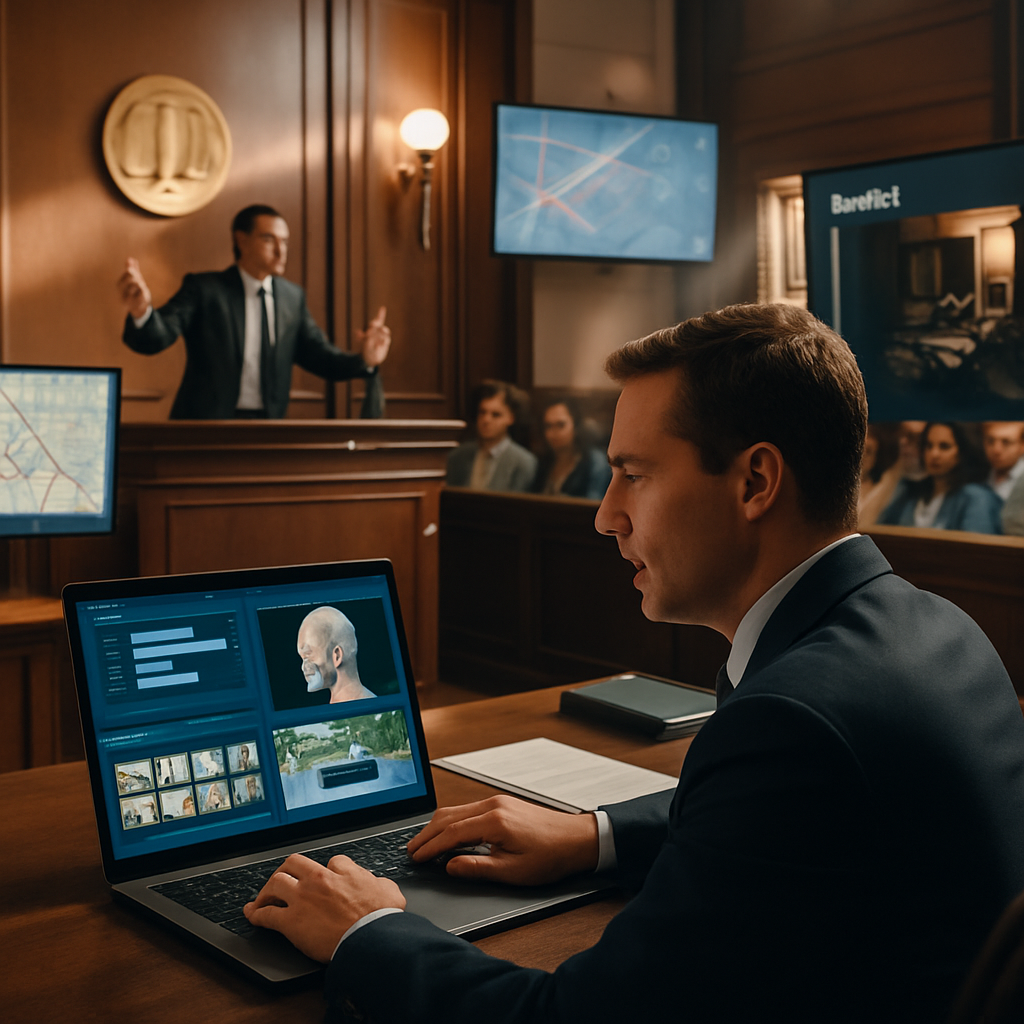

I’ve been running Persuadius—and its prior incarnations—for 30 years. And in all that time, I’ve rarely seen a product fall out of favor as quickly as TrialDirector.
To be clear, I don’t personally operate trial-presentation software in court. That’s not my role. But I do run a company that lives inside high-stakes trial environments, and I manage a team of trial technicians who spend their working lives in the hot seat—running evidence, cueing clips, solving last-minute chaos, and keeping lawyers calm when everything is happening at once.
And across the board, my technicians have told me the same thing:
OnCue is simply better.
Not “a little better.” Not “more modern.”
Vastly better.
And once a trial team finds something that’s faster, cleaner, more reliable, and less stressful, the market doesn’t “gradually transition.” It snaps.
That’s what happened here.
TrialDirector didn’t just lose market share. It lost momentum. And in trial work, momentum is everything.
The Trial Tech Reality: Courtroom Software Lives or Dies in the Hot Seat
Let’s start with something that trial lawyers often underestimate:
Trial presentation software isn’t chosen by committee.
It’s chosen by the person who has to run it when:
-
the judge is staring at you
-
the witness is dodging the question
-
opposing counsel is objecting every six seconds
-
the partner wants three exhibits pulled up instantly
-
the video clip starts at the wrong timestamp
-
and everyone turns around and looks at the tech like they’re the pilot in a turbulence event
In that environment, small differences become massive differences.
A platform that is:
-
slightly faster
-
slightly clearer
-
slightly less error-prone
-
slightly more intuitive under pressure
…doesn’t win by 10%. It wins by 90%.
Which brings us to the real story of OnCue vs. TrialDirector.
TrialDirector Had the Early Lead. OnCue Built the Better Modern Tool.
TrialDirector was the name for a long time. It was the default. It was what many teams used because it had been around, it had inertia, and it was “what trial people used.”
But courtroom practice has changed in the last 10–15 years in ways that punish older systems.
Trials now involve:
-
more video (depositions, bodycam, surveillance, interviews)
-
more digital exhibits
-
more last-minute exhibit swapping
-
more remote witnesses and hybrid presentations
-
more expectation of clean, professional visual delivery
Which means trial presentation software can’t just function.
It has to function beautifully.
And my technicians have told me that OnCue is built for the way modern trials are actually run.
Why OnCue Took Over: What the People Running Trials Actually Care About
I’m not going to turn this into a feature-by-feature spec sheet. That’s not how real decisions get made in trial world.
Here’s what matters.
1) Speed Under Pressure (Not Just “Capabilities”)
Plenty of software can technically display an exhibit.
But the real question is:
How fast can you get it on screen when everything is moving?
When lawyers switch mid-thought and say:
“Pull up the email where he admits it… no, not that one… the other one… the one from March…”
The technician needs a system that makes it easy to:
-
locate it instantly
-
confirm it visually
-
publish it cleanly
-
and move on without drama
OnCue, in my team’s experience, wins in the category that matters most: getting the right thing up, fast, without friction.
2) Stability and Confidence (Because Failure Is Public)
In trial, the cost of “glitchy” isn’t annoying.
It’s humiliating.
The lawyer looks bad. The team looks sloppy. And credibility—once lost—does not come back.
Courtroom tech needs to feel like a seatbelt:
You don’t think about it. You trust it. It just works.
My technicians describe OnCue as more dependable and more confidence-building—meaning they can focus on execution instead of fighting the software.
3) Cleaner Workflow and Less Complexity
Software that was designed in an older era often shows its age in the same way:
It can do a lot… but it makes you work too hard to do it.
The courtroom isn’t a place where you want:
-
extra steps
-
multiple windows
-
clunky processes
-
confusing menus
-
workarounds that “everyone just learns”
Trial techs don’t want to “learn tricks.” They want the workflow to make sense.
And again: by technician report, OnCue simply feels more intuitive and efficient.
4) Video Handling Is Now a Non-Negotiable
If you haven’t tried to run deposition clips smoothly in a real courtroom, here’s the truth:
It’s not as simple as pressing play.
Everything matters:
-
exact clip boundaries
-
exact start times
-
audio confidence
-
visual clarity
-
switching between clips and exhibits quickly
If video is clumsy, the persuasion suffers.
When video is seamless, it looks like power.
And this is one of the biggest reasons modern trial teams have moved hard toward OnCue.
5) Tech Adoption Spreads Like Word-of-Mouth (Because It Is Word-of-Mouth)
Nobody wants to be the only team using the “old” platform when other teams have moved on.
Trial technicians talk.
Consultants talk.
Litigation support teams talk.
And once the ecosystem reaches a tipping point, the switch accelerates.
That’s why this change happened so fast: it wasn’t just preference—it became the new normal.
So Why Did TrialDirector Fade So Quickly?
This is the part that surprises people.
Usually, legacy products linger for years.
But TrialDirector didn’t merely become “less popular.” It became less recommended.
And there’s a huge difference between those two things.
When a product becomes less recommended by the people who are in the trenches, it’s done.
Because trial is too stressful for nostalgia.
Nobody wants to bring a tool into court that the tech team doesn’t love.
If You’re a Lawyer, Here’s the Practical Takeaway
The question isn’t:
“Which software is more feature-rich?”
The question is:
“Which platform produces less courtroom risk and more courtroom control?”
Because that’s what you’re really buying.
Not software.
Not a license.
Control.
If You’re Staffing a Trial Team, Choose What Your Trial Techs Prefer
This may be the simplest advice in the entire post:
If you have strong trial technicians and they all tell you one platform is better, listen to them.
They are the ones who will be blamed if it doesn’t work.
They are also the ones who make the lawyer look effortless when it does work.
My team’s message has been consistent:
OnCue makes the hot seat easier, smoother, and more reliable.
And once the hot seat gets easier, the marketshare shift isn’t mysterious. It’s inevitable.
Final Thought: In Trial Work, Better Tools Don’t Win Slowly
Some products win gradually.
Trial-presentation software doesn’t.
When something meaningfully reduces friction in court, it spreads at courtroom speed:
Fast, decisive, and irreversible.
That’s what I’ve watched happen with OnCue.
And it’s why, for most modern trial teams, TrialDirector isn’t a competitor anymore.
It’s a chapter that already ended.
Want help building a trial team that runs clean, persuasive courtroom visuals?
At Persuadius, we’ve supported high-stakes trial teams nationwide for three decades—often on short notice—with:
If you’d like to talk through your next trial, hearing, or arbitration, schedule a 15-minute case consultation, and we’ll help you figure out the smartest way to staff and support the courtroom. Yes, we can still support TrialDirector if you need it.


Leave a Comment