


Part 4 of the Persuasion Occasion podcast series with Perkins Coie (see parts 1, 2, 3, and the full podcast on Spotify)
Trial consultants love stories.
Unfortunately, facts occasionally insist on participating.
One of my favorite persuasion lessons comes from an antitrust matter involving the proposed merger of two of the largest airlines at the time. The case never produced quite the courtroom drama we imagined. The matter settled a couple of weeks before trial, and like many high-stakes cases, the final resolution came before every argument could be fully tested in court.
Yet one demonstrative from that matter taught me more about persuasion than many cases that actually went to verdict.
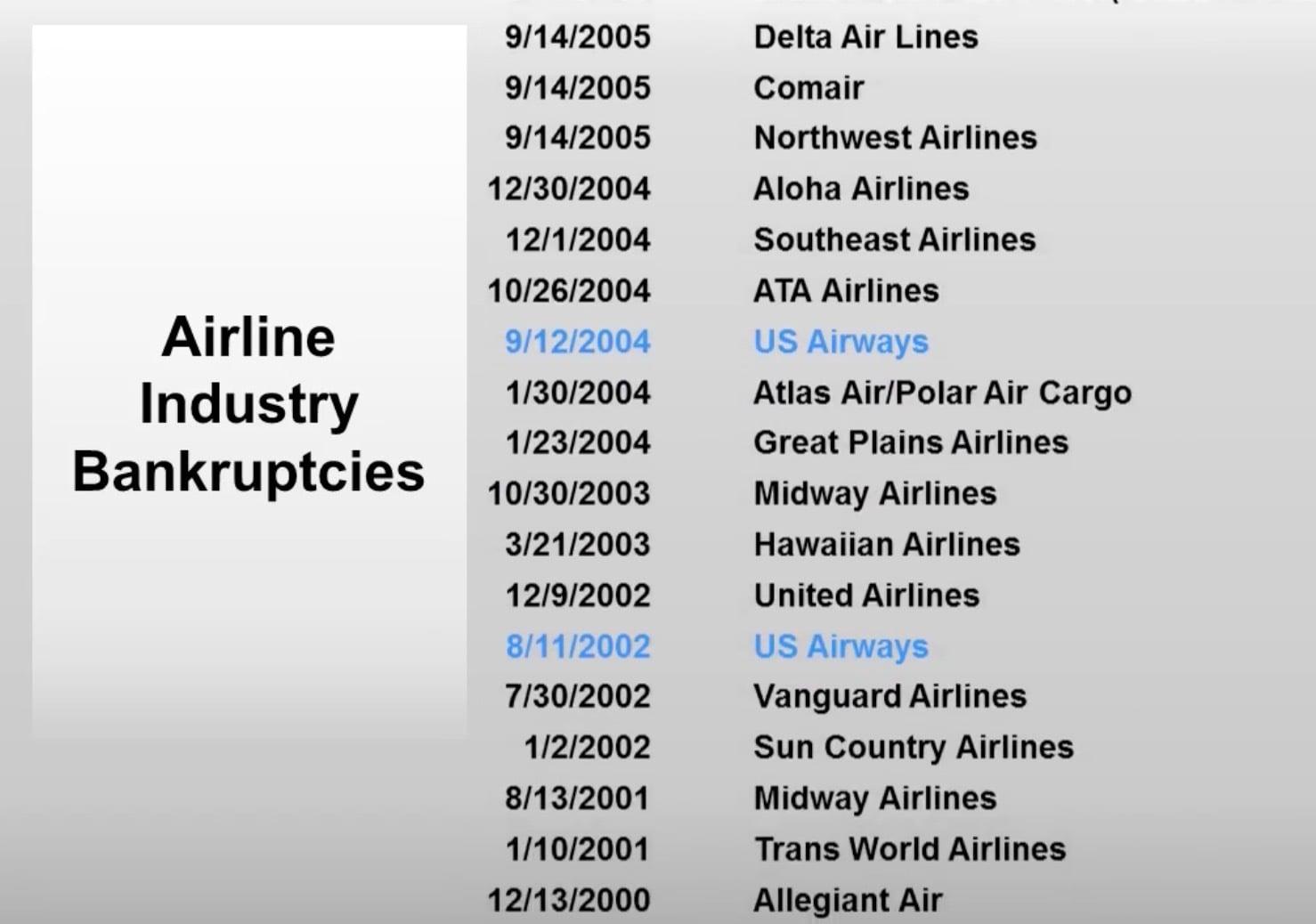
The exhibit was almost embarrassingly simple.
It wasn't a 3D animation.
It wasn't a sophisticated economic model.
It wasn't a dazzling piece of trial graphics.
It was a slowly scrolling list of airline bankruptcies.
Just a list.
One name after another.
Many of them familiar.
Eastern.
Pan Am.
TWA.
Braniff.
People of a certain age recognize these names immediately. They were once household brands. Today, they're gone.
And as the list continues to scroll, something interesting happens.
You start to see the airline industry differently. Here's my explanation below:
Every Audience Arrives with a Story
One of the recurring themes we've discussed throughout this series is that people don't enter a courtroom as blank slates.
Judges don't.
Jurors don't.
Executives don't.
Everyone arrives carrying a story.
In an antitrust case involving a major merger, the story often sounds something like this:
- Big companies are getting bigger.
- Competition is shrinking.
- Consumers may ultimately pay the price.
Those aren't irrational assumptions. In many situations, they may be entirely reasonable.
But effective persuasion often isn't about proving those assumptions wrong.
It's about helping the audience recognize that the situation may be more complicated than they initially believed.
That's where the bankruptcy exhibit came in.
The exhibit wasn't designed to tell anyone what conclusion to reach.
It wasn't designed to prove that the merger should be approved.
It simply introduced another reality that many people hadn't considered:
The airline business is incredibly difficult.
The Goal Wasn't to Win an Argument
Lawyers sometimes assume that every demonstrative must directly prove a legal point.
I disagree.
The most effective demonstratives often serve a different purpose.
They provide context.
They help the audience see a problem from a perspective they hadn't previously considered.
The scrolling list of airline failures wasn't arguing.
It was reminding.
Reminding viewers that despite the public perception of airlines as giant corporations, the industry itself has historically been brutal.
Failure is common.
Profitability is elusive.
Even famous companies disappear.
Whether or not that fact ultimately changes the legal outcome is almost beside the point.
The exhibit succeeded because it caused people to pause.
And in persuasion, a pause can be incredibly valuable.
The Most Important Moment in Persuasion
Many lawyers think persuasion begins when the audience agrees with them.
In reality, persuasion often begins much earlier.
It begins when the audience stops being certain.
The most important transition is often not:
"You're right."
It's:
"I hadn't thought about it that way."
That small shift opens the door to everything else.
It creates curiosity.
It weakens confirmation bias.
It encourages people to examine evidence they might otherwise dismiss.
And remarkably, that shift is often created not by a brilliant legal argument but by a simple visual.
The Lesson Applies Far Beyond Antitrust
Although this example comes from an antitrust matter, the principle applies everywhere.
In product liability litigation, the overlooked fact may be how difficult it is to design a product that is both safe and practical.
In employment litigation, it may be the challenge of managing thousands of employees across multiple locations.
In construction disputes, it may be the countless variables affecting schedules and budgets.
Every case contains facts that the audience has not fully considered.
The best demonstratives don't always answer the ultimate question.
Sometimes they simply illuminate those forgotten facts.
Simplicity Wins
After nearly three decades in litigation consulting, I've learned that some of the most persuasive visuals are also the simplest.
Not because audiences dislike complexity.
But because simple visuals allow audiences to discover a truth for themselves.
The airline bankruptcy exhibit wasn't memorable because it was flashy.
It was memorable because it was undeniable.
One company after another.
One bankruptcy after another.
A visual reminder that the story was more complicated than it first appeared.
And that's often the highest goal of persuasion.
Not to tell people what to think.
To help them see something they hadn't seen before.
Work With Persuadius
If you’re preparing for trial and need help breaking through judge or juror bias—whether through jury research, litigation graphics, or in-court strategy—we can help.
- Book a free 15-minute case consultation: https://calendly.com/kenlopez/15-minute-case-consultation
- Or email us confidentially: confidential@persuadius.com


Leave a Comment