


Part 3: Insights from the Persuasion Occasion Podcast with Perkins Coie
Most trial lawyers understand confirmation bias in theory.
Fewer know how to actually break it in real time—inside a courtroom, with a jury that has already made up its mind.
That’s exactly where this next insight comes in.
In my conversation with David Biderman and Jasmine Wetherell on the Persuasion Occasion podcast from Perkins Coie, we got into a technique that sounds counterintuitive at first… and then becomes hard to ignore.
The Problem: Most Jurors Decide Early—and Stay There
If you’ve tried cases, you’ve felt this.
Jurors don’t wait until closing argument to decide.
They decide early—often during opening statement—and then spend the rest of the trial doing something very human:
They filter.
They listen for what confirms their initial impression…
and quietly dismiss what doesn’t.
That’s confirmation bias, and it’s one of the most powerful forces in the courtroom.
Once it locks in, persuasion becomes exponentially harder.
The Counterintuitive Solution: Make Them Work
Here’s where things get interesting.
During the interview, I floated a technique I haven’t seen widely used—but I believe has enormous potential:
If you want a juror to really process something…
make it slightly harder to process.
Not confusing. Not sloppy.
Just enough friction to force engagement. I've included that video conversation below:
The “Desirable Difficulty” Effect in the Courtroom
There’s a concept in cognitive psychology often referred to as desirable difficulty—when something requires a bit more effort, people process it more deeply and remember it better.
In the courtroom, that can translate into something surprisingly simple:
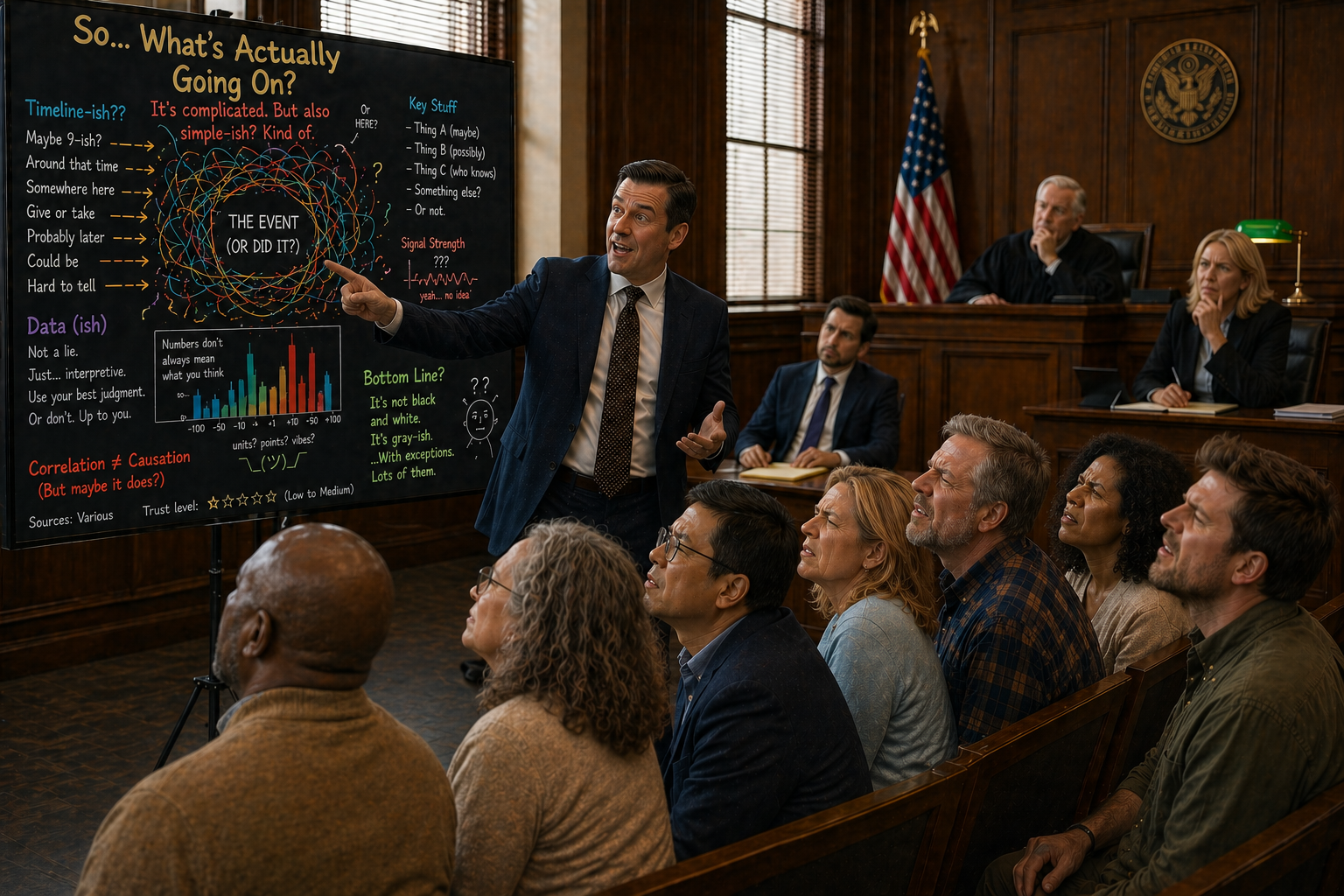
- A font that’s slightly harder to read
- A visual that doesn’t instantly “click”
- A slide that makes the juror pause and ask: “Wait—what is this?”
That pause matters.
Because in that moment, the juror is no longer passively confirming what they already believe.
They are actively thinking.
Why This Breaks Confirmation Bias
In the podcast, David captured it perfectly:
You’re forcing the jury to figure out how this connects.
Exactly.
And that “figuring out” is the key.
When a juror has to:
- Re-read
- Re-examine
- Reconcile something unexpected
…they momentarily step outside their confirmation bias.
That’s your opening.
A Strategic Use Case: When You’re the “Bad Guy”
This technique isn’t for every moment.
In fact, used incorrectly, it could be distracting or even irritating.
But there’s one scenario where it becomes especially powerful:
When the jury has already decided you’re the villain.
If you’re defending:
- A large corporation
- An unpopular position
- A fact pattern that feels wrong at first glance
…you are fighting uphill against early bias.
And traditional clarity—while still essential—may not be enough.
In those moments, introducing a controlled moment of friction can:
- Interrupt the narrative the juror has settled into
- Re-open cognitive processing
- Create a second chance to be heard
A Word of Caution (This Isn’t About Being Clever)
Let’s be clear.
This is not an invitation to:
- Use ugly slides
- Confuse your audience
- Abandon the core principles of great trial graphics
In fact, those principles still rule:
- One idea per visual
- Instantly understandable structure
- No unnecessary text
But within that framework, there’s room—sparingly—for something unexpected.
Something that makes the juror pause.
The Bigger Idea: Engagement Beats Passive Agreement
The real takeaway isn’t about fonts or visuals.
It’s about engagement.
A juror who passively agrees with you is good.
A juror who actively thinks through your argument is far more powerful.
Because that juror has now participated in the persuasion you are offering up.
And once someone participates, they’re far more likely to own the conclusion.
Watch the Full Conversation
This insight is just one moment from a broader conversation with Perkins Coie’s litigation team on persuasion, storytelling, and trial strategy.
👉 Watch the full Persuasion Occasion interview here:
https://perkinscoie.com/insights/podcast/ken-lopez-persuadius-explains-what-actually-persuades-jury
Final Thought
Most trial strategy focuses on making things easier for the jury.
And that’s usually right.
But occasionally—strategically—making something just a little harder…
…might be exactly what gets them to finally see your case.
Work With Persuadius
If you’re preparing for trial and need help breaking through juror bias—whether through jury research, litigation graphics, or in-court strategy—we can help.
- Book a free 15-minute case consultation: https://calendly.com/kenlopez/15-minute-case-consultation
- Or email us confidentially: confidential@persuadius.com
Related Persuadius Articles
If you’re thinking more deeply about juror bias, persuasion, and how real juries actually process information, these articles are worth your time:
- Managing Juror Bias
https://persuadius.com/blog/managing-juror-bias - How to Pick a Nearly Perfect Jury Without Doing a Mock Trial
https://persuadius.com/blog/how-to-pick-a-nearly-perfect-jury-without-doing-a-mock-trial - The Impact of Cognitive Bias on Jury Interpretation and Persuasion
https://persuadius.com/blog/the-impact-of-cognitive-bias-on-jury-interpretation-and-persuasion - Jury Persuasion Techniques: Using Surprise to Overcome Boredom and Confirmation Bias in the Courtroom
https://persuadius.com/blog/jury-persuasion-techniques-using-surprise-to-overcome-boredom-and-confirmation-bias-in-the-courtroom - Why Fear Beats Logic in the Courtroom (Part 1 – Perkins Coie Podcast)
https://persuadius.com/blog/why-fear-beats-logic-in-the-courtroom-insights-from-a-perkins-coie-podcast-part-1 - Simplifying Your Opening Statement to Its Core (Part 2 – Perkins Coie Podcast)
https://persuadius.com/blog/simplifying-your-opening-statement-to-its-core-part-2-insights-from-the-persuasion-occasion-podcast-with-perkins-coie


Leave a Comment