

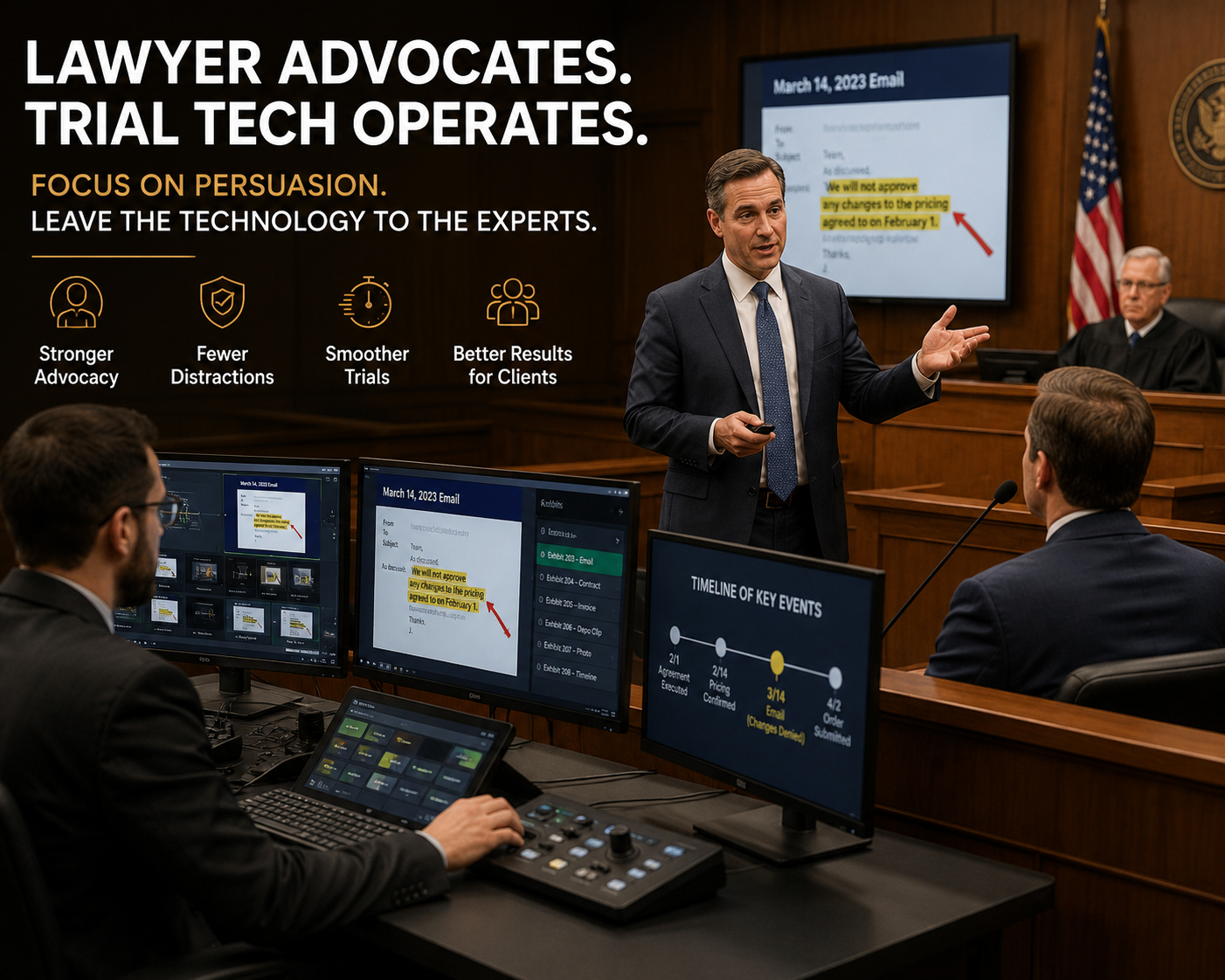

There is a particular moment in trial that I have seen far too many times.
A lawyer is standing in front of the jury. The lawyer is prepared. The question is good. The witness has just given exactly the answer everyone hoped for.
Now the lawyer wants Exhibit 237 on the screen.
And suddenly the trial stops.
The lawyer turns toward the laptop.
Clicks something.
Nothing happens.
Clicks again.
The wrong document appears.
Someone at counsel table whispers something.
The lawyer looks back at the screen.
The jury looks at the lawyer.
And a moment that should have been about the evidence has become a moment about the technology.
This is almost entirely preventable.
Just as I recently argued in Why Lawyers Should Stop Designing Their Own PowerPoint Slides, lawyers should generally not be spending their time designing their own courtroom graphics.
I would take that principle one step further:
Trial lawyers should not be running their own trial technology either.
Not because lawyers cannot learn the technology.
Of course they can.
The question is why they would want to divide their attention between two completely different jobs at precisely the moment when their powers of persuasion matter most.
The Trial Lawyer Has One Job: Persuade
Trial is cognitively demanding.
During an examination, a good trial lawyer is simultaneously monitoring the witness, listening for nuances in the answer, watching the judge, anticipating objections, thinking several questions ahead, assessing the jury's reaction, remembering the evidentiary record, and deciding whether the original examination plan should change.
That is quite enough.
Now add:
Where is the exhibit?
Which window is active?
Did the video load?
Why is the document appearing on the attorney monitor but not the jury monitor?
Which button produces the callout?
Did I accidentally advance the PowerPoint?
Can I get back to the previous slide?
Where is the impeachment clip?
Why isn't the audio playing?
The problem is not simply that technology can malfunction.
The larger problem is that operating technology consumes attention that should be directed toward advocacy.
A professional trial technician—sometimes called a hot-seater—removes that cognitive burden.
The lawyer thinks about the witness.
The trial tech thinks about the screen.
That division of labor is enormously valuable.
Relinquish the Clicker. Really.
I made essentially the same argument years ago in Trial Lawyers, Relinquish the Clicker.
The clicker looks harmless.
It isn't.
I have watched excellent lawyers accidentally jump ahead in their presentations, struggle to return to the correct slide, lose their place, become frustrated, and eventually abandon portions of presentations they had spent weeks preparing.
And the technology problem rarely stays a technology problem.
The lawyer gets flustered.
That changes body language.
The pace changes.
Eye contact disappears.
The lawyer begins looking toward the screen or laptop rather than toward the judge or jury.
Momentum disappears.
The audience notices.
That is why giving up the clicker actually produces more control, not less.
A lawyer who has rehearsed properly with a trial technician can simply speak.
The exhibit appears.
The photograph enlarges.
The key sentence highlights.
The deposition clip plays.
The timeline advances.
The lawyer does not visibly command any of it.
To the jury, the visual presentation simply seems to follow the lawyer's thoughts.
When it is done well, it can look effortless.
Of course, it isn't effortless at all.
It is rehearsed.
Great Trial Technology Should Be Almost Invisible
Some lawyers worry that using a sophisticated trial technician makes a presentation look overly produced.
In my experience, the opposite is usually true.
Badly operated technology calls attention to itself.
Great trial technology disappears.
The jury should not be thinking:
"Wow, they have an impressive computer system."
They should be thinking:
"I understand what happened."
The best trial technician operates almost like an invisible member of the advocacy team.
As we explained in What a Great "Hot Seat Operator" Can Add to a Trial Team, an experienced technician contributes much more than computer skills.
The best trial technicians spend enormous amounts of time in courtrooms. They see what works. They see what fails. They see what irritates judges. They understand courtroom rhythm. They learn how different lawyers communicate. And they become extraordinarily good at anticipating what is likely to happen next.
When the relationship between lawyer and trial technician is working properly, the technician may be pulling up the next exhibit before the lawyer has finished asking for it.
That is not technology support.
That is teamwork.
TrialDirector Was Once State-of-the-Art. Trial Technology Has Moved On.
There is an important update to some of our older writing about trial technology.
In 2012, we published 5 Tips for Using TrialDirector and Trial Technicians Effectively.
At the time, we described inData's TrialDirector as state-of-the-art trial presentation software.
And at the time, it was.
But 2012 might as well be another technological era.
Today, Persuadius trial technicians overwhelmingly prefer OnCue for modern courtroom presentation. In a more recent article, OnCue vs. TrialDirector: How One Trial-Presentation Platform Took Over, I discussed why our technicians have moved so decisively toward OnCue.
TrialDirector is still commercially available, so it would be inaccurate to say the software literally no longer exists. But within our own trial technology practice, OnCue has become the preferred modern platform. Reveal continues to market TrialDirector, while OnCue continues actively releasing and supporting its current courtroom presentation software.
But here is the important point:
The software itself is not the competitive advantage.
The person operating it is.
Giving OnCue to someone who occasionally presents exhibits is not the same thing as putting an experienced trial technician in the hot seat.
It is like handing someone a professional camera and calling them a cinematographer.
Tools matter.
Mastery matters much more.
Trial Is a Terrible Place to Learn Technology
One of the mistakes we identified years ago in The 14 Most Preventable Trial Preparation Mistakes was asking associates or paralegals without sufficient trial-presentation experience to serve as trial technicians.
We described a case in which a trial team had insufficiently experienced personnel running the presentation and the courtroom sat waiting for roughly ten minutes during opening statements while the technology problem was addressed.
Ten minutes may not sound like much.
Try standing silently in front of twelve jurors for ten minutes while your opening statement has stopped.
It feels like an eternity.
And it creates an impression.
Prepared versus unprepared.
Organized versus disorganized.
Confident versus rattled.
Professional versus amateur.
Jurors may not understand what caused the technical failure.
They don't need to.
They experience the failure.
Trial presentation is performance, and timing is part of persuasion.
A Trial Technician Does Things a Lawyer Shouldn't Be Thinking About
Modern courtroom technology involves much more than advancing a PowerPoint.
A trial technician may be responsible for displaying and enlarging exhibits, highlighting portions of documents, creating document callouts on the fly, coordinating multiple monitors, playing synchronized deposition testimony, moving instantly among exhibits, handling audio and video, preparing impeachment material, coordinating with courtroom personnel, troubleshooting connections, maintaining redundant systems, tracking changes to demonstratives, and adapting when the judge suddenly rules that something can—or cannot—be shown.
OnCue can make many of these tasks remarkably fast in the hands of someone who knows it well. The software is specifically designed around presenting case evidence, deposition clips, documents, annotations, and other trial materials.
But the operative phrase is "in the hands of someone who knows it well."
The trial technician may perform these operations hundreds or thousands of times.
The lawyer may conduct a trial every few years.
Who should be pressing the buttons?
The answer seems obvious.
The Economics of DIY Trial Technology Don't Make Much Sense Either
There is also a financial argument.
In last month's PowerPoint article, I pointed out the strange economics of having expensive lawyers perform graphic-design work.
The same logic applies here.
Imagine an associate billing hundreds of dollars per hour spending dozens of hours building trial databases, troubleshooting video formats, preparing deposition clips, configuring courtroom equipment, learning software shortcuts, and rehearsing technical workflows.
Perhaps the associate can do all of those things.
But is that the highest-value use of the associate's time?
Probably not.
Those hours could instead be spent preparing witnesses, studying testimony, improving examination outlines, anticipating evidentiary problems, developing themes, preparing impeachment, or refining the story of the case.
That is legal work.
Trial technology is a specialized discipline.
Using specialists is not an indulgence when the stakes are high.
Frequently, it is simply efficient allocation of resources.
Good Trial Technicians Also Handle the Unexpected
This may be their greatest value.
Trials do not follow scripts.
A witness unexpectedly denies something.
Opposing counsel opens a door.
The judge changes a ruling.
A lawyer suddenly wants an exhibit that nobody expected to use until Thursday.
A deposition clip becomes relevant that nobody planned to play.
The lawyer says:
"Pull up the March 14 email."
A strong trial technician does not say:
"Give me five minutes."
The technician finds it.
Displays it.
Highlights it.
And the examination continues.
That responsiveness can dramatically change the rhythm of a cross-examination.
The evidence appears while the point is alive.
The jury sees the contradiction immediately.
The lawyer retains momentum.
There is an enormous difference between eventually showing something and showing it at exactly the moment it matters.
Technology Problems Become Credibility Problems
Lawyers sometimes describe trial technology failures as inconveniences.
I think that understates the problem.
Courtroom presentation communicates preparation.
If one side repeatedly struggles to display exhibits, searches for files, apologizes for technical problems, turns toward the laptop, or asks the jury to wait, people begin forming impressions.
Maybe consciously.
Maybe unconsciously.
By contrast, when evidence appears instantly and naturally, the trial team looks organized and in command of the case.
That does not mean a slick presentation wins a weak case.
It doesn't.
But poor execution can absolutely interfere with the presentation of a strong one.
Technology should amplify credibility, not consume it.
The Best Trial Lawyer Should Look Like Nothing Else Exists
Watch an exceptional trial lawyer supported by an exceptional trial technician.
The lawyer is looking at the witness.
Or the jury.
Or the judge.
Not the laptop.
Not the projector.
Not the clicker.
An exhibit suddenly appears.
The lawyer continues speaking.
A critical paragraph enlarges.
The lawyer continues speaking.
A photograph replaces it.
The lawyer continues speaking.
A deposition clip plays.
Then the screen goes dark because the visual has served its purpose and the jury's attention should return to the lawyer.
That coordination is extremely difficult to reproduce while simultaneously conducting the examination and operating the computer yourself.
And why would you try?
The lawyer should be doing the thing the lawyer uniquely knows how to do:
persuade.
Everything else should support that objective.
Lawyers Should Practice Law. Trial Technicians Should Run Trial Technology.
My argument here is essentially the same one I made about lawyers designing their own PowerPoint presentations.
Knowing the technology is good.
Understanding what is possible is essential.
Being able to communicate intelligently with your trial technician is valuable.
But understanding a tool and personally operating that tool during the most important moments of a multimillion-dollar trial are entirely different things.
If your client has millions—or billions—of dollars at stake, ask yourself a simple question:
Do you really want your first-chair lawyer thinking about which button to press?
I don't.
I want that lawyer thinking about the next question.
The next objection.
The witness.
The jury.
The story.
And ultimately, winning the case.
Let somebody else run the technology.
Related Persuadius Articles
- Why Lawyers Should Stop Designing Their Own PowerPoint Slides
- Trial Lawyers, Relinquish the Clicker
- 5 Tips for Using TrialDirector and Trial Technicians Effectively
- The 14 Most Preventable Trial Preparation Mistakes
- What a Great "Hot Seat Operator" Can Add to a Trial Team
- OnCue vs. TrialDirector: How One Trial-Presentation Platform Took Over
- 9 Reasons to Use a Trial Technician
Need Trial Technology Support for an Upcoming Trial?
Persuadius provides experienced trial technicians and hot-seat operators for trials, hearings, and arbitrations nationwide. We can also integrate trial technology with litigation graphics, jury consulting, and opening-statement support so that your courtroom presentation operates as one coordinated persuasion strategy.
Book a free 15-minute case consultation to discuss your upcoming trial and the right courtroom technology team for it.
For matters requiring discretion, you can also contact Persuadius directly for a confidential conflict check.


Leave a Comment