

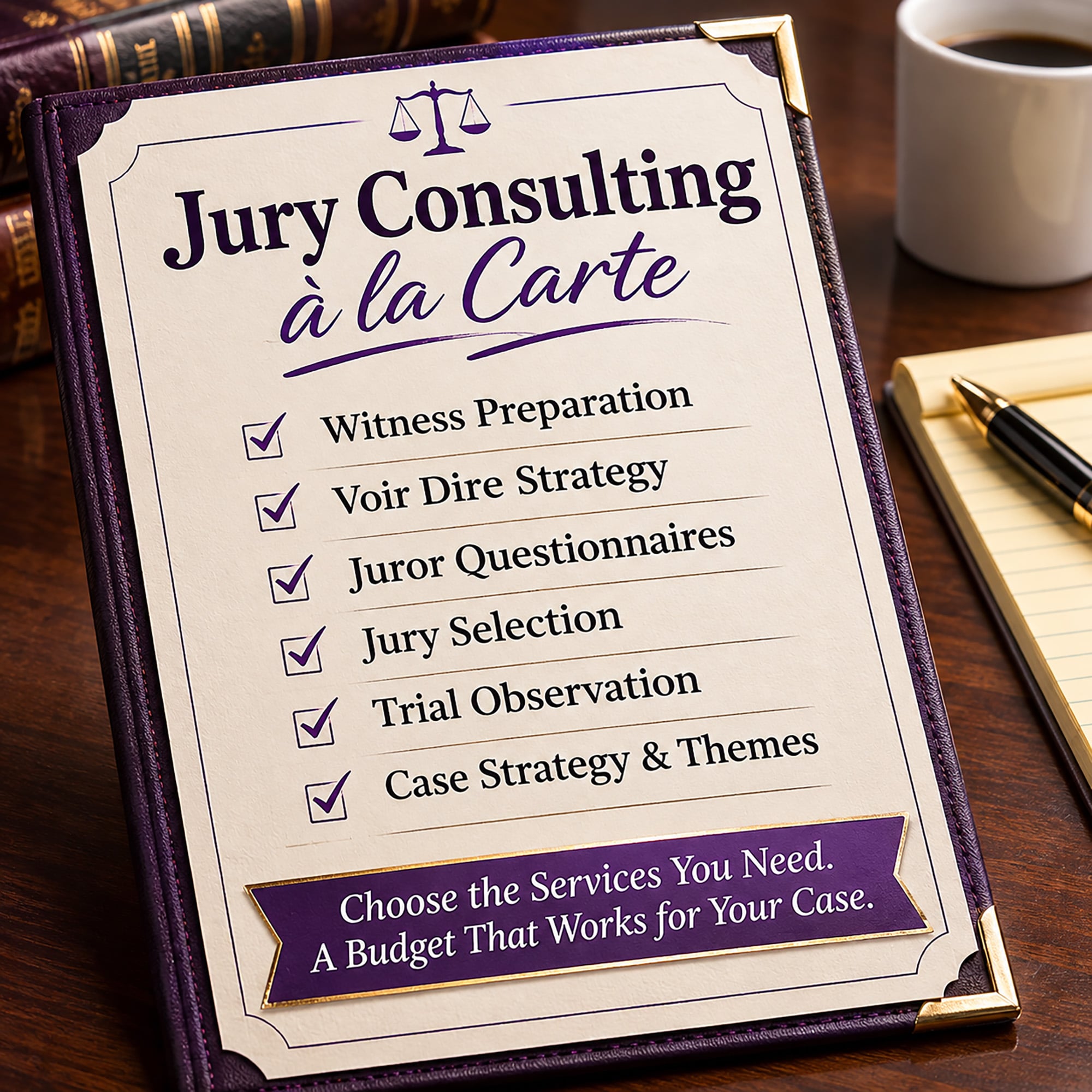

You don't need a six-figure research budget to get the benefit of decades of jury consulting experience. In fact, some of the most valuable jury consulting services are surprisingly affordable.
When trial lawyers think about jury consulting, they usually think about mock trials, focus groups, shadow juries, and sophisticated jury research projects.
And for good reason.
These services can provide extraordinary insights into how jurors think, what arguments persuade them, which witnesses they believe, and where a case may be vulnerable.
At Persuadius, we've spent more than 30 years helping trial lawyers understand jurors and improve their chances of success through these kinds of research.
But there's something many attorneys don't realize.
You can hire an experienced jury consultant without conducting any jury research at all.
You can hire one for a few hours. For a day. For jury selection. For witness preparation. Or to provide an independent perspective during trial.
And you can select precisely the services you need, rather than committing to a large research engagement.
In fact, some of the most useful work our jury consultants do takes place outside the traditional mock trial or focus group setting.
Here are ten ways trial lawyers regularly benefit from experienced jury consultants without commissioning a full jury research project.
1. Juror Questionnaire Development and Review
Juror questionnaires can be among the most valuable sources of information available to trial counsel.
But there's a substantial difference between collecting information and knowing what to do with it.
An experienced jury consultant can help develop questionnaires that go beyond basic demographic questions to uncover attitudes, experiences, and beliefs that may influence how prospective jurors evaluate your case.
If questionnaires have already been completed, a consultant can review them individually, identifying answers that deserve further investigation.
For example, in a commercial fraud case, a prospective juror's experience with financial institutions may matter considerably more than their occupation or education.
In a medical malpractice case, a juror's experience caring for a family member may reveal attitudes that are not immediately apparent from conventional questioning.
The value isn't simply identifying what jurors have experienced. It's understanding how those experiences might influence their interpretation of your evidence.
And importantly, this work can be performed on a limited, hourly basis.
2. Individual Juror Profiling and Assessment
Not every case requires a comprehensive juror profiling study.
Sometimes, what attorneys need is an experienced second set of eyes.
A jury consultant can evaluate individual prospective jurors using questionnaire responses, available background information, and observations during voir dire.
The objective is to identify potential concerns, favorable characteristics, inconsistencies, and areas that warrant additional questioning.
This is particularly valuable when a lawyer is confronting a large panel and must make consequential decisions with limited information.
Rather than relying exclusively on intuition, counsel can supplement their judgment with the perspective of someone who has spent years studying how jurors evaluate evidence and make decisions.
For more on this approach, see our article, How to Pick a Nearly Perfect Jury Without Doing a Mock Trial.
3. Panel-Wide Analysis and Juror Ranking
Individual juror assessments are useful. Understanding the panel as a whole can be even more valuable.
A jury consultant can analyze completed questionnaires across the entire panel to identify recurring attitudes, shared experiences, and potential sources of bias.
Perhaps a surprisingly large percentage of prospective jurors express distrust of corporations. Or several have experiences that could influence their reactions to expert testimony.
These patterns can help counsel understand the broader environment in which jury selection will take place.
Consultants can also develop comparative rankings of prospective jurors, helping attorneys prioritize their attention and evaluate selection options.
No ranking system can predict how an individual will ultimately vote. But a disciplined, case-specific assessment can help lawyers make better-informed decisions.
4. Voir Dire Strategy and Question Development
Many attorneys prepare voir dire questions by adapting lists they've used in previous cases.
That's understandable. It's also a missed opportunity.
Every case has its own psychological challenges.
A patent case may involve attitudes toward large technology companies. A product liability case may raise questions about personal responsibility. An antitrust case may require understanding how jurors think about competition and corporate behavior.
A jury consultant can help identify the attitudes most likely to matter and develop questions designed to uncover them.
Just as importantly, a consultant can help attorneys ask questions in ways that encourage candid answers rather than socially acceptable ones.
Good voir dire isn't about getting prospective jurors to agree with you. It's about discovering what they already believe.
Understanding those existing beliefs is especially important given the power of confirmation bias in the courtroom. We explored this phenomenon in our article, How to Break Juror Confirmation Bias (Using a Surprisingly Simple Trick).
This service can be particularly valuable for attorneys who have limited experience selecting juries or who are preparing for an unfamiliar jurisdiction or case type.
5. Real-Time Jury Selection Assistance
Jury selection moves quickly.
Answers are incomplete. Impressions change. New information emerges. And attorneys must make decisions while simultaneously questioning prospective jurors, tracking responses, and thinking about their case.
An experienced jury consultant can provide an independent perspective throughout the process.
The consultant can monitor answers, identify follow-up opportunities, flag inconsistencies, and help counsel evaluate potential strikes.
This assistance can be provided without conducting a mock trial or any other pretrial research.
For attorneys facing a particularly consequential jury selection, even a relatively short consulting engagement can be worthwhile.
And because the consultant is focused entirely on evaluating prospective jurors, trial counsel can devote more attention to questioning and courtroom strategy.
6. Witness Preparation That Goes Beyond Rehearsing Testimony
Witness preparation is another area where jury consultants can provide substantial value without an extensive research engagement.
Attorneys naturally focus on the legal substance of testimony.
Jury consultants bring a complementary perspective: How will the witness actually be perceived by the people deciding the case?
A witness may be completely truthful and still appear evasive.
An expert may be exceptionally knowledgeable and still confuse the jury.
A corporate executive may believe they're projecting confidence while jurors perceive arrogance.
Experienced consultants help witnesses recognize how their tone, facial expressions, body language, and communication habits influence credibility.
They also help witnesses practice listening carefully, answering questions directly, avoiding unnecessary elaboration, and remaining composed during difficult questioning.
For deposition preparation, this can include helping witnesses understand how opposing counsel develops testimony and seeks admissions.
The objective is never to change truthful testimony or manufacture a performance. It's to help witnesses communicate accurately, clearly, and credibly under pressure.
Sometimes a few hours of focused preparation can reveal communication problems that might otherwise remain undiscovered until the witness is on the stand.
7. Trial Observation and Juror Feedback
Once trial begins, attorneys have an enormous amount to manage.
They're examining witnesses, responding to objections, coordinating exhibits, working with experts, and preparing for the next day.
What they often cannot do is devote their full attention to observing the jury.
That's where a jury consultant can help.
An experienced consultant can observe the proceedings and provide an independent perspective on apparent juror reactions.
Which testimony seems to command attention?
Where does the jury appear confused?
Are jurors struggling with a particular expert's explanation?
Does a witness's demeanor appear to undermine an otherwise compelling account?
Of course, body language is not a reliable way to determine what someone is thinking, and courtroom observations cannot establish how a juror will vote.
But careful observation can identify moments that deserve attention and provide useful feedback about the clarity and delivery of a case.
This is especially helpful when trial counsel has become so immersed in the details of litigation that it becomes difficult to experience the presentation as a first-time listener.
8. Opening Statement and Closing Argument Consultation
At Persuadius, we've long emphasized that effective trial persuasion depends on storytelling, simplicity, and understanding the audience.
Those principles are central to our opening statement work, but they also inform the work of our jury consultants.
An experienced consultant can review an opening statement or closing argument and evaluate it from a juror's perspective.
Is the central theme clear?
Does the presentation explain why the case matters?
Are the most important facts memorable?
Are there assumptions that make sense to the attorneys but may be confusing to people hearing the case for the first time?
Is the presentation asking jurors to absorb too much information?
A consultant can help identify weaknesses in the narrative, anticipate juror concerns, and suggest ways to make the presentation more accessible and persuasive.
As we discussed in Give Jurors the Words: Building Arguments They Can Carry into the Deliberation Room, one of the objectives of trial persuasion is to equip jurors with arguments they can remember, explain, and use during deliberations.
We've also written extensively about Why Trial Lawyers Should Consider Outsourcing Their Opening Statements.
This can be done as a focused review rather than as part of a larger research engagement.
Sometimes what an opening statement needs most isn't another lawyer's opinion. It's the perspective of someone trained to think about how jurors receive information.
9. Trial Theme and Case Strategy Consultation
Lawyers often spend years developing a case.
That familiarity is an advantage, but it can also create blind spots.
Facts that seem enormously important to the litigation team may have little emotional significance to jurors.
Conversely, a seemingly minor detail may influence how jurors interpret the entire dispute.
An experienced jury consultant can provide a fresh perspective on the case narrative, evaluate competing themes, identify potential credibility problems, and help counsel anticipate juror reactions.
This can be particularly valuable before mediation, before opening statements are finalized, or when a litigation team is debating how to present a difficult issue.
As we explained in Why Bullet Points Are Killing Your Persuasion: Lessons from Our Conversation with Perkins Coie, presenting more information doesn't necessarily make an argument more convincing.
The engagement need not involve weeks of research.
It might consist of reviewing key case materials, discussing the evidence with the trial team, and participating in a focused strategy session.
The goal is straightforward: identify the strongest persuasive path through the evidence before the jury hears it.
10. Targeted Consulting for a Single Problem
Perhaps the most overlooked benefit of working with a jury consultant is that you don't necessarily need to hire one for an entire case.
You can hire a consultant to address one specific concern.
Maybe you have a difficult expert witness.
Maybe you're worried about how jurors will react to an unsympathetic corporate client.
Maybe your case involves complicated damages calculations.
Maybe you need help selecting a jury in a jurisdiction where you've never tried a case.
Or perhaps you simply want an experienced professional to challenge your assumptions before you walk into court.
These are all legitimate reasons to engage a jury consultant.
And they don't require a large research budget.
You can buy the experience without buying the entire research project.
What Does Jury Consulting Cost Without a Mock Trial?
This is where the conversation gets particularly interesting.
Traditional jury research can require substantial resources. Recruiting participants, organizing research sessions, preparing materials, analyzing results, and reporting findings all contribute to the cost.
But many of the services described above have a completely different cost structure.
Instead of paying for a comprehensive research project, clients can engage an experienced consultant for a defined assignment.
Some services can be billed hourly. Others can be scoped around a specific deliverable, preparation session, or day of assistance.
For example, a client might request:
- A review of completed juror questionnaires.
- Several hours of witness preparation.
- A voir dire strategy session.
- Assistance during jury selection.
- A review of an opening statement.
- One or more days of trial observation.
These services can be purchased individually or combined to meet the needs of the case.
The cost depends on the scope, the consultant's time, and the circumstances of the engagement.
But the important point is that the absence of a substantial jury research budget does not mean jury consulting is beyond your reach.
You Don't Have to Choose Between a Full Mock Trial and No Jury Consulting
Too often, attorneys think about jury consulting as an all-or-nothing proposition.
Either the case justifies a comprehensive mock trial or focus group, or the litigation team proceeds without outside assistance.
We believe that's a false choice.
There are excellent reasons to conduct traditional jury research, particularly in complex, high-stakes litigation.
But there are also excellent reasons to bring an experienced jury consultant into a case for a single day, a single witness, or a single important decision.
The same professional judgment that helps design and interpret sophisticated jury research can also help attorneys prepare questions, evaluate jurors, strengthen testimony, and improve trial presentations.
And those benefits are available in engagements of many different sizes.
At Persuadius, we work with trial lawyers handling everything from relatively modest disputes to some of the country's largest and most consequential litigation.
We understand that not every case has the same budget.
That's why we encourage attorneys to tell us what they're trying to accomplish and what resources they have available.
We'll help identify the services that make the most sense.
Because the question shouldn't always be, "Can we afford a mock trial?"
Sometimes the better question is:
"What could an experienced jury consultant help us do better, and how much assistance do we actually need?"
You may be surprised by how affordable the answer can be.
Let's Talk About Your Case
You don't need a large jury research budget to benefit from Persuadius's 30 years of experience.
Whether you need help with juror questionnaires, voir dire, jury selection, witness preparation, trial observation, or overall case strategy, we can help you design an engagement that fits your needs.
Schedule a free 15-minute case consultation to discuss your case, your concerns, and your budget.
Or send us a confidential email describing the assistance you're looking for.
We'll help you determine whether a targeted jury consulting engagement makes sense for your case.
New Jury Consulting book coming soon! Sign up to be the first to know about it!

Leave a Comment