


Pharmaceutical product liability trials are some of the most difficult cases a jury will ever be asked to decide. They are built on science, filtered through fear, and decided by people who usually know very little about either. That is what makes jury consulting for pharmaceutical product liability trials so important.
Most trial teams prepare these cases as if the verdict will turn on technical accuracy. Sometimes it does. More often, it turns on whether jurors understand the science, trust the witnesses, and believe the story makes sense.
That distinction shapes everything.
In pharmaceutical cases, jurors are rarely deciding between “right” and “wrong” science. They are deciding which side made the science understandable, which witnesses felt credible, and which narrative gave them the clearest path to a verdict. That is why pharmaceutical litigation trial consulting matters. It is not just about polishing arguments. It is about understanding how jurors think before they decide.
At Persuadius, we work with trial teams to test the themes, witnesses, and visual strategies that shape outcomes in complex pharmaceutical matters. The goal is not simply to present a stronger case. It is to understand how jurors will actually receive it.
Why Pharma Product Liability Cases Are So Difficult for Jurors
Pharmaceutical trials ask jurors to do something unusual. They must absorb highly technical evidence, weigh expert disagreement, evaluate corporate conduct, and make decisions about risk, responsibility, and causation—often all at once.
That is a difficult task for any jury.
A typical pharmaceutical product liability case may require jurors to understand:
- clinical trial design
- adverse event data
- regulatory timelines
- physician decision-making
- warnings and labeling
- epidemiology and causation
- internal corporate conduct
- competing scientific experts
Lawyers often assume jurors will process this information analytically. Most do not.
Jurors process complex evidence the way all people do: through intuition first, then logic second. They ask themselves whether the company seems trustworthy. Whether the plaintiff feels credible. Whether the risk seems foreseeable. Whether the science sounds honest or evasive.
That is why many pharmaceutical cases are not won by the side with the best science. They are won by the side that makes the science easier to believe.
Why Product Liability Jury Research Matters Early
One of the most common mistakes in pharmaceutical litigation is waiting too long to test how jurors actually respond to the case.
By the time most trial teams hear genuine juror reactions, they are already in trial.
That is too late.
Product liability jury research allows trial teams to test how jurors react to the central components of the case before those reactions harden into trial risk. It helps answer the questions that matter most:
- Which liability themes feel intuitive?
- Which scientific explanations create confusion?
- Which corporate documents trigger anger?
- Which witnesses build trust?
- Which damages themes feel legitimate?
- Which arguments sound defensive, even when true?
These are not academic questions. They are often the difference between a theory that looks persuasive in a conference room and one that survives deliberation.
Good product liability jury research also reveals something trial teams often miss: jurors do not react to scientific complexity by thinking harder. They often react by simplifying. They reduce complex evidence into intuitive judgments about motive, trust, and responsibility.
That simplification is predictable. It can also be tested.
What Mock Trials and Focus Groups Actually Reveal
Many lawyers think mock trials and focus groups are useful because they tell you who is winning.
That is not their greatest value.
The best mock trials and focus groups reveal why jurors are leaning one way, what facts they are using to justify that position, and which themes they carry into deliberation.
That is far more useful.
A well-designed mock in a pharmaceutical case does not just test verdict preference. It shows:
- where jurors assign blame
- which expert they trust and why
- what evidence they ignore
- which phrases they repeat in deliberation
- what they misunderstand
- what makes them angry
- what gives them permission to compromise
Those insights often reshape the case more than any expert report.
Mock trials and focus groups are especially valuable in pharmaceutical matters because jurors rarely deliberate the way lawyers expect. They do not move cleanly through legal elements. They build narratives. They search for coherence. They look for a moral center.
That is what should be tested.
Why Jury Selection and Voir Dire Strategy Matter More in Pharma
In many cases, jury selection is important.
In pharmaceutical cases, jury selection and voir dire strategy can be decisive.
These jurors do not walk into court as blank slates. They bring opinions about:
- pharmaceutical companies
- corporate profit
- chronic illness
- personal responsibility
- medical risk
- scientific expertise
- government regulation
- lawsuits in general
Some jurors assume pharmaceutical companies put profits over safety. Others assume plaintiffs are blaming companies for risks they willingly accepted. Many hold both views at once.
That is what makes jury selection and voir dire strategy so important in these cases. The goal is not simply to identify bias. It is to identify which biases matter, which are movable, and which will dominate deliberation.
Strong jury selection and voir dire strategy helps trial teams identify:
- anti-corporate bias that may drive liability
- distrust of experts that may undermine science
- deference to regulators that may benefit the defense
- skepticism toward damages claims
- emotional responses to health and safety themes
- jurors whose life experiences may shape risk perception
The most dangerous juror is not always the one with the strongest opinion. It is often the one whose beliefs align most naturally with the other side’s narrative.
Trial Strategy Consulting Is Really About Narrative Discipline
In pharmaceutical trials, trial strategy consulting is often framed as case refinement.
In practice, it is usually about narrative discipline.
These cases generate enormous amounts of information. The temptation is to present all of it. That is almost always a mistake.
Jurors do not reward completeness. They reward clarity.
The most effective trial strategy consulting in pharmaceutical matters helps trial teams decide:
- what the case is really about
- which science matters most
- which witnesses carry trust
- which themes should lead
- what evidence belongs in the background
- what the jury must remember after deliberations begin
That kind of discipline is difficult in technically dense cases. It is also where many verdicts are won.
Jurors do not need every fact. They need the right facts, in the right order, attached to the right story.
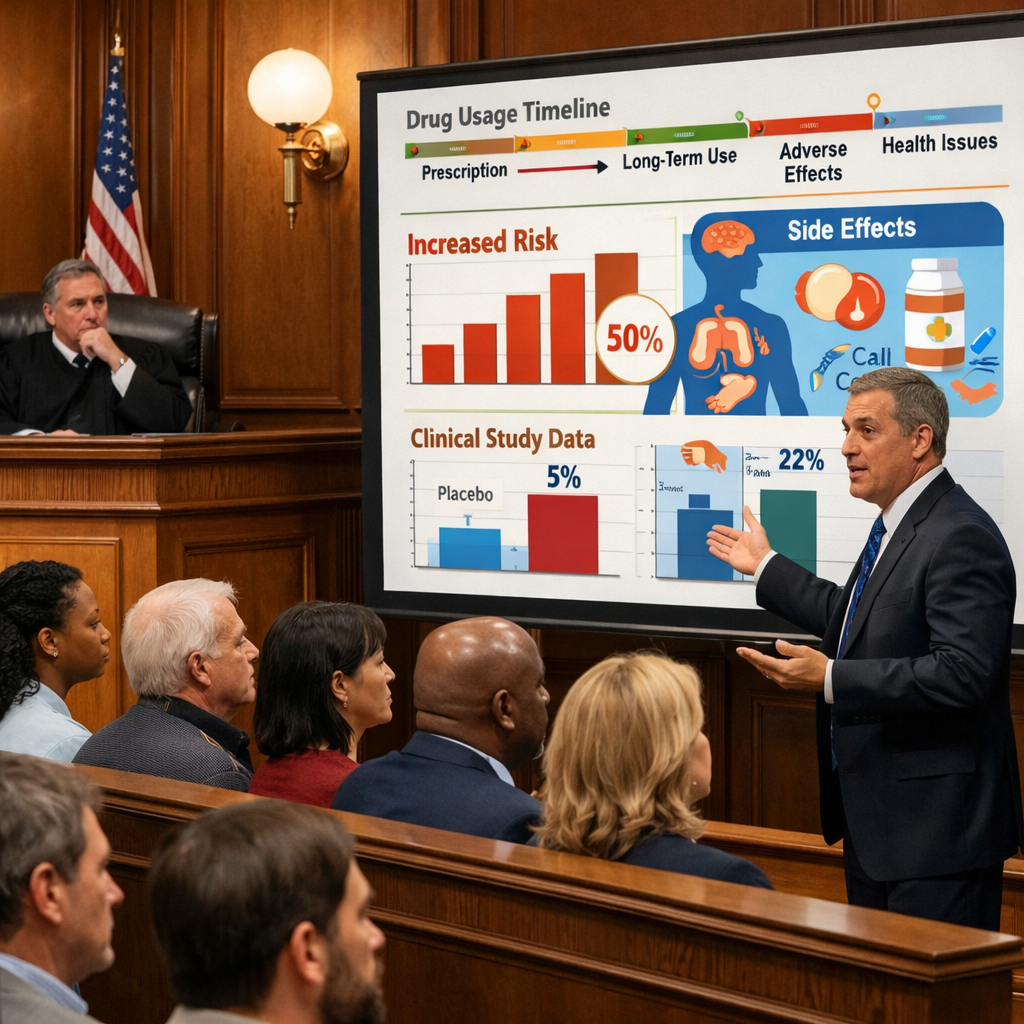
Why Trial Graphics Matter More in Pharma Than Almost Anywhere Else
In pharmaceutical litigation, the side that explains the science most clearly usually has the advantage.
This is where trial graphics stop being presentation tools and become persuasion tools.
Good trial graphics in pharmaceutical cases do more than illustrate evidence. They reduce complexity, impose structure, and help jurors retain meaning.
That may include:
- mechanism-of-action visuals
- regulatory timelines
- warning evolution graphics
- adverse event charts
- clinical study simplification
- corporate knowledge timelines
- causation frameworks
The value is not just visual clarity. It is cognitive relief.
Jurors are more likely to trust information they can organize. In pharmaceutical cases, graphics often provide that structure.
The point is not to simplify science until it becomes shallow. The point is to simplify it until it becomes usable.
What Good Jury Consulting Really Does
The best jury consulting for pharmaceutical product liability trials does not just make a case more polished. It makes it more testable, more understandable, and more aligned with how jurors actually decide difficult cases.
That is the real value of pharmaceutical litigation trial consulting.
It helps trial teams see the case as jurors will see it. It sharpens product liability jury research. It improves mock trials and focus groups. It strengthens jury selection and voir dire strategy. It gives trial strategy consulting a clearer foundation.
Most importantly, it helps trial teams stop guessing what jurors will do with complicated evidence and start testing what they actually will.
That is how better trial decisions get made.
If you are preparing for a pharmaceutical matter, that kind of clarity is not just useful. It is often the difference between a case that feels strong in preparation and one that proves strong in deliberation.
Work With Persuadius on Your Next Pharma Trial
If you are preparing for a pharmaceutical product liability matter, the right jury consulting strategy can strengthen every major trial decision—from theme development to voir dire to verdict.
Persuadius helps trial teams build clearer narratives, test critical arguments, and make smarter decisions before trial begins.
Book a free 15-minute case consultation: https://calendly.com/kenlopez/15-minute-case-consultation
Or send a confidential email to confidential@persuadius.com
Related Articles and Free Resources on Pharma, Science, and Product Liability Litigation
If this article is useful, the next step is to go deeper into the science, strategy, and visual persuasion issues that tend to decide pharmaceutical and science-heavy cases. The following Persuadius resources are especially relevant for trial teams handling pharmaceutical product liability trials, toxic tort matters, and other technically dense litigation.
Related Articles
- Making the Complex Understandable in Pharmaceutical Cases
A practical look at one of the central problems in pharmaceutical litigation: how to translate scientific complexity into testimony and visuals jurors can actually understand. Especially useful for teams wrestling with expert-heavy drug and device cases. - 10 Key Expert Witness Areas to Consider in Your Next Toxic Tort Case
A strong primer on the scientific disciplines that often shape science-based litigation, including toxicology, epidemiology, and biostatistics. Particularly useful when building expert strategy in pharmaceutical and product liability matters. - Why Expensive-Looking Litigation Graphics Are Better
A useful reminder that jurors often equate visual polish with credibility. In pharmaceutical cases, where complexity already creates skepticism, visual authority can materially affect how evidence is received. - Teaching Science to a Jury: A Trial Consulting Challenge
A foundational article on the central challenge in science-heavy litigation: not proving the science to experts, but teaching it clearly enough for jurors to use it in deliberation. - 7 Reasons the Consulting Expert is Crucial in Science-Based Litigation
A useful overview of why consulting experts often shape the case long before testifying experts ever take the stand, especially in complex scientific and pharmaceutical litigation. - Using a Genetic Defense in Asbestos and Talc Cases: An Interview with David H. Schwartz, Ph.D.
A valuable look at how genetics and precision medicine are reshaping causation arguments in toxic tort and product liability litigation, with direct implications for pharmaceutical causation strategy.
Recommended Free Downloads
- Free Download: Using Science to Prevail at Trial or As an Advocate
A strong foundational resource for litigators handling cases built around scientific evidence, expert testimony, and causation. Frequently useful in pharmaceutical and toxic tort matters. - Free Download: The Environmental Litigation Trial Presentation & Trial Prep E-Book
Particularly useful for litigators handling technical causation disputes, expert-heavy records, and scientific evidence presentation. Many of the same lessons apply directly to pharmaceutical product liability trials. - Free E-Book: The Litigator’s Guide to Combating Junk Science – 2nd Edition
Especially relevant in cases where expert credibility, methodological rigor, and causation attacks will drive trial strategy. A useful companion for pharmaceutical litigation teams facing aggressive expert disputes.

Leave a Comment