

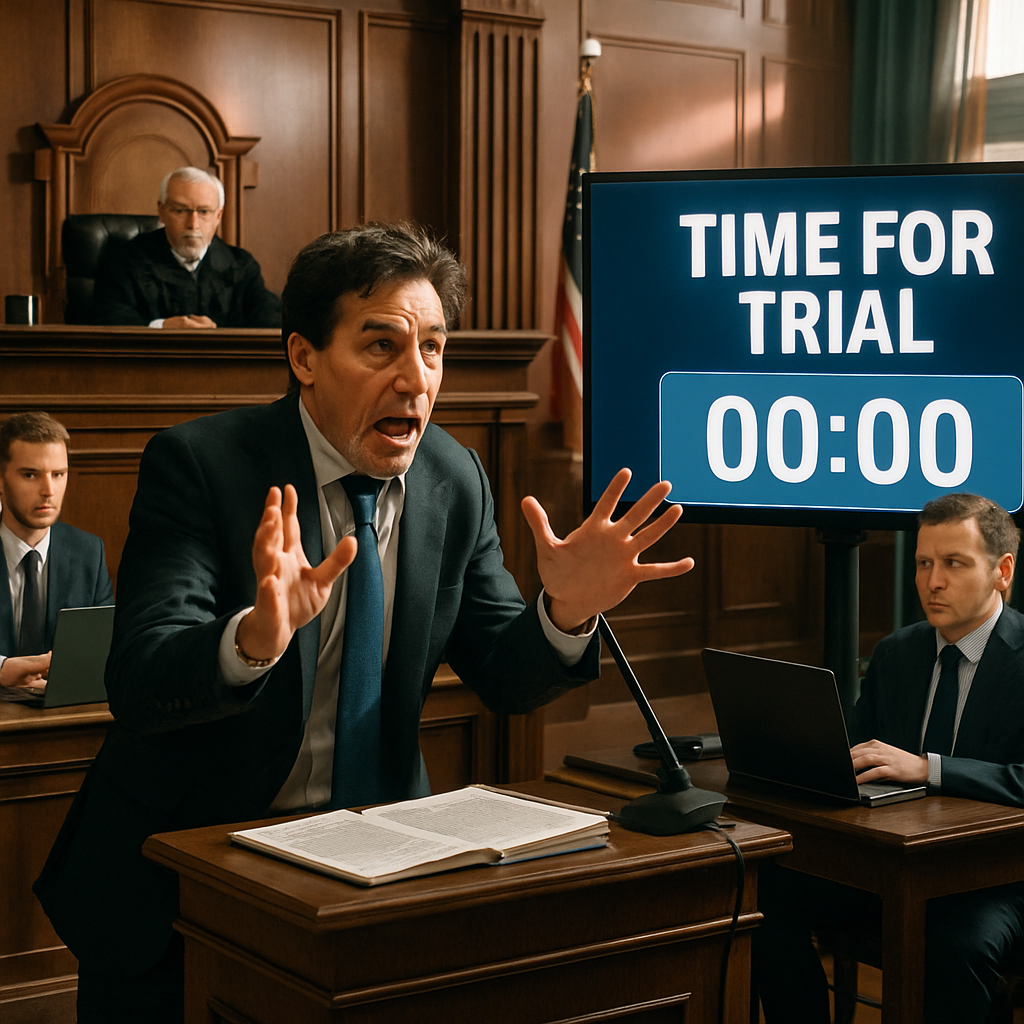

Some lawyers know what a trial presentation company does. Other lawyers do not—not really.
For those that do not, they hire a trial presentation firm because trial is coming, the exhibits are a mess, and someone needs to run the screen so the lead lawyer can focus on questioning witnesses instead of fumbling with a clicker.
That’s the whole need, right?
Not exactly.
Some trial presentation companies are truly litigation consulting companies—and some are simply exhibit operators with good equipment and a clean suit. There’s nothing wrong with the latter, as far as it goes. But Persuadius was built for something deeper: lawyers and Ph.D.’s who can help you design persuasive trial graphics, sharpen themes, test jury reaction, and run the courtroom presentation as part of a strategy, not as a technical function.
A trial presentation company can help you run your slides.
But if that’s all you’re hiring for, you’re buying a $10 solution to a $10 million problem. Or $10 billion.
Because when trial lawyers call us late in the game—usually with that slightly strained tone that says “we’re fine, everything’s fine, please help us immediately”—it’s almost never because they need somebody to press “next.”
It’s because they’re realizing something far more important:
Trial isn’t about having information. It’s about controlling attention.
And attention is fragile.
(If you want a surprisingly good example of how professionals control attention with visuals, see: How Trial Presentation Companies Can Turn Data into Impact—Lessons from Texas Flood Visuals.)
The Myth: “We Just Need Someone to Run the Tech”
Here’s the common misconception.
A case team thinks the trial presentation company is there for the mechanical stuff:
-
load exhibits
-
display documents
-
play deposition clips
-
create a few trial graphics
-
make sure the courtroom monitor isn’t black when the judge walks in
That’s all real work. It matters.
And to be fair, there are plenty of scenarios where having a dedicated hot-seat operator is the single smartest decision you can make. (If you’re on the fence, read: 9 Reasons to Use a Trial Technician.)
But none of that is the reason trial presentation support changes outcomes.
The real value isn’t the technology.
The real value is how smoothly the story moves through that technology, without breaking the spell.
Because the spell—whether you call it persuasion, credibility, momentum, trust—can be shattered in one moment.
And once it breaks, it’s hard to get back.
The Truth: You’re Not Hiring a Vendor. You’re Buying Courtroom Control.
When you hire a great trial presentation company, you’re buying:
-
story discipline
-
pacing
-
visual clarity
-
credibility
-
repetition without boredom
-
simplicity without distortion
-
the ability to stay calm under pressure
-
the ability to pivot when reality changes
That last one is everything.
Because real trials don’t follow the rehearsal.
Witnesses don’t behave.
Opposing counsel gets creative.
Judges make rulings that vaporize key demonstratives.
And somehow, your team still needs to look composed, prepared, and trustworthy.
That’s the job.
And it’s why some trial teams hire a technician… while others hire a trial presentation company that can provide technicians and deeper consulting support.
1) A Trial Presentation Company Helps Your Opening Statement Actually Work
Most openings fail for a painfully simple reason:
They are true…
…but they are not coherent.
They have facts, but no gravity.
They have chronology, but no story.
They have a theme, but it isn’t repeated enough to stick.
And they have slides—lots of slides—but no sense of what the jury is actually absorbing.
If you’re serious about winning the opening, you can’t treat it like a speech. You have to treat it like a moment of decision—because that’s what it is. (A good starting point is: Top 10 Articles About Opening Statements.)
This is where opening statement drafting support (done correctly) becomes part of trial presentation work.
Not because someone “writes your opening” like a speechwriter.
But because a strong trial team helps you do the hard work of:
-
-
deciding what story you’re really telling
-
stripping away the clever-but-unnecessary parts
-
putting the most persuasive fact earlier than feels comfortable
-
structuring the narrative so the jury can follow it even if they miss a sentence
-
pairing words and visuals so they reinforce—not compete
-
If you want a timeless, old-school Persuadius/A2L example of how deep this goes, see: 7 Ways to Draft a Better Opening Statement.
And if you want a more modern “this is what elite litigators actually do” version, see: 21 Secrets From an Opening Statement Guru.
A trial presentation company should make your opening feel like this:
“I understand. I trust this lawyer. This case makes sense.”
Not:
“I’ll pretend I’m following and hope it gets clearer later.”
2) It Turns Litigation Graphics Into Understanding (Instead of Decoration)
Let’s clear up another misconception:
Litigation graphics are not art.
They are not “trial bling.”
They are not decorations you tack onto a case after the lawyers have done the real work.
They are how modern jurors understand modern cases.
Because modern cases are not simple.
They involve:
-
-
technical causation
-
years of timeline events
-
corporate decision-making
-
scientific mechanisms
-
data, statistics, models
-
money that exists only as numbers in a spreadsheet
-
You can explain these things verbally.
But jurors don’t retain them verbally.
They retain what they can see.
And the best trial presentation companies don’t treat graphics as decoration. They treat graphics as narrative control.
If you want the short version of what “winning graphics” actually means, read: The 3 Rules of Trial Graphics That Win Cases.
And if you want the “how did this become so important?” version, read: How I Used Litigation Graphics as a Litigator and How You Could Too.
A good trial presentation company knows how to turn complexity into clarity through:
-
-
timelines that make the sequence feel inevitable
-
side-by-side comparisons that stop jurors from doing mental math
-
graphics that show scale without exaggeration
-
visuals that reveal what matters and remove what doesn’t
-
call-outs that focus attention exactly where you need it
-
When teams ask us for “trial graphics,” what they usually mean is:
“Please help us make the jury understand this without working so hard.”
And that’s the right request.
3) It Protects You From the Moment the Courtroom Turns Against You
This is the part nobody puts on their website.
But it’s the real reason trial teams hire us.
Trials have breaking points.
Moments where things go sideways:
-
-
the video won’t play
-
the callout isn’t pulling correctly
-
the exhibit is mislabeled
-
the judge wants the next witness now
-
opposing counsel objects mid-slide
-
the jury starts staring at the screen like they’re trying to decode a treasure map
-
If you’ve ever watched the jury look away from the lawyer and toward the screen—and then watched the lawyer not notice—you’ve seen the problem in real time.
We wrote about that exact phenomenon here: Overcoming the Split-Attention Effect: A Litigation Graphics Consultant’s Daily Challenge.
And then you watch something subtle happen:
The lawyer’s confidence drops.
Not dramatically.
Just a half-step.
And jurors notice.
They notice because jurors are always asking themselves:
“Are these people in control?”
It’s not fair, but it’s true.
A good trial presentation company keeps you in control by being prepared, redundant, and calm.
4) It Helps You Test Reality Before Trial (And That Includes Jury Work)
Some lawyers associate jury consulting with one narrow purpose:
“Help us pick a better jury.”
That’s part of it.
But it’s not the most valuable part.
The most valuable part of jury consulting is this:
It tells you what your case looks like to normal humans.
Because you don’t try cases to lawyers.
You try them to jurors.
And jurors don’t think like you.
That’s why Persuadius has always lived in the overlap between story, visuals, and people.
(And yes, that’s also why “trial technician-only” vendors can’t do what true litigation consulting companies do.)
5) It Runs the Hot Seat Like a Weapon (Not a Job Description)
Now we can talk about the trial technician.
Because yes: the trial technician runs the exhibits.
But the best ones do something much more important.
They preserve momentum.
They preserve rhythm.
They preserve credibility.
They make cross-examination feel sharp and inevitable because the evidence appears instantly, cleanly, and confidently.
If you want a deeper dive into what separates the good from the great, we’ve written multiple posts on it, including:
And if you want the “new Persuadius” version of the argument—the one with teeth—see:
Why Trial Technicians Are the Secret Weapon in High-Stakes Litigation. (Persuadius)
Why Most Lawyers Hire a Trial Presentation Company Too Late
Here’s the blunt version:
Most lawyers hire trial presentation support when they’re already in trouble.
Not ethically.
Not strategically.
But structurally.
They’re too deep in complexity.
They have too much evidence.
Too many loose ends.
Too many themes.
Too many slides.
Too much anxiety.
And they’re asking a trial presentation company to solve in five days what should have been shaped in five weeks.
That’s still fixable.
We do it all the time.
But it’s expensive—in stress, time, and opportunity.
Because at that point, you’re not buying strategy.
You’re buying rescue.
And rescue is always harder than strategy.
The Question to Ask Before You Hire Anyone
If you want to know whether you’re dealing with a true trial presentation company—or just a vendor who makes slides—ask this:
“How do you help lawyers control attention in trial?”
Not “What software do you use?”
Not “How many graphics can you make?”
Not “Do you do animations?”
Control attention.
Because in the end, that’s what persuasion is.
(For a recent example of how fast the courtroom tech world changes—and why having the right team matters—see: OnCue vs. TrialDirector: How One Trial-Presentation Platform Took Over and the Other Quietly Vanished.) (Persuadius)
If You’re Headed Toward Trial, Let’s Talk
If you’re looking for a trial presentation company to support your next matter—whether that means:
-
opening statement drafting support
-
litigation graphics / trial graphics
-
trial technician (“hot seat”) support
-
jury research, focus groups, or jury selection strategy
…we’re happy to talk.
You don’t need a 45-minute pitch deck.
You need clarity.
You need a plan.
You need someone who’s done this hundreds of times and can keep you steady when it gets loud.
Schedule a free 15-minute call here:
https://calendly.com/kenlopez/15-minute-case-consultation
or
Send us a confidential email to confidential@persuadius.com.
Because trial is coming whether you’re ready or not.
And the best time to build courtroom control is before you need rescuing.
Additional Reading (Persuadius)
Here are a few related articles if you want to go deeper:
-
15 Conversations to Have BEFORE You Hire Your Trial Technician (Persuadius)
-
9 Hidden Skills of Trial Technicians and Hotseaters You Never Knew About (Persuadius)
-
Trial Technician vs. Paralegal: What’s the Difference? (Persuadius)
-
Why Trial Technicians Are the Secret Weapon in High-Stakes Litigation (Persuadius)
-
Overcoming the Split-Attention Effect: A Litigation Graphics Consultant’s Daily Challenge (Persuadius)
-
How Trial Presentation Companies Can Turn Data into Impact—Lessons from Texas Flood Visuals (Persuadius)


Leave a Comment