


The billable hour is expensive. So why are so many litigators spending it doing graphic design?
Every trial lawyer I know has done it.
The witness outlines are finished. The opening statement is coming together. Trial is three weeks away. Someone says, "I'll just build the PowerPoint myself."
It feels efficient.
It almost never is.
After nearly three decades of watching courtroom presentations succeed and fail, I've become convinced that one of the most expensive mistakes lawyers make isn't a bad objection, a weak cross-examination, or even forgetting an exhibit.
It's believing that because PowerPoint is easy to use, effective courtroom persuasion is easy to create.
Those are two entirely different skills.
Great trial lawyers are not necessarily great presentation designers
Nobody expects a talented litigator to also be an architect.
Or an accountant.
Or a cinematographer.
Yet somehow we've convinced ourselves that because Microsoft PowerPoint is installed on every laptop, every attorney should also become a visual communicator.
That's a strange assumption.
The best trial graphics combine psychology, storytelling, graphic design, cognitive science, and an understanding of how jurors process information. Those disciplines aren't taught in law school, and they aren't mastered by clicking through PowerPoint templates.
The irony is that many lawyers spend years mastering the Federal Rules of Evidence while spending almost no time learning how people actually absorb visual information.
Your audience isn't reading your slides—they're deciding your case
Most attorneys create slides as though they are preparing notes for themselves.
Jurors don't see them that way.
Jurors experience every slide as part of a story.
A cluttered slide tells them the case is complicated.
Tiny text tells them the lawyer isn't confident enough to simplify.
Bullet points tell them they're about to be lectured instead of persuaded.
Every visual choice communicates something—whether you intended it or not.
Research in cognitive psychology has repeatedly shown that people remember information better when visuals reinforce a spoken narrative rather than compete with it. When audiences are forced to simultaneously read paragraphs while listening to a speaker, comprehension and retention suffer because attention is split between two competing tasks.
Unfortunately, that's exactly what many courtroom PowerPoints ask jurors to do.
Lawyers optimize for accuracy.
Graphic designers optimize for understanding.
Those aren't always the same thing.
Lawyers understandably want every qualifier, every exception, every citation, every date, and every fact on the screen.
Professional presentation designers ask a different question:
"What does the audience need to understand right now?"
Those are radically different objectives.
A persuasive trial presentation isn't a written brief projected on a wall.
It's visual storytelling.
The hidden cost of DIY PowerPoint
Many firms assume they're saving money by having associates create demonstratives.
Are they?
Let's do the math.
Suppose an associate bills $450 per hour.
If that associate spends 40 hours building slides—and that's conservative for a major trial—the firm has invested $18,000 in graphic design.
Not legal strategy.
Graphic design.
Now ask another question.
Did those forty hours produce graphics equal to what experienced litigation designers produce every day?
Usually not.
Even worse, every hour spent aligning text boxes or searching for icons is an hour not spent preparing witnesses, refining themes, anticipating objections, or strengthening the case itself.
Lawyers should practice law.
Designers should design.
Everyone wins.
Good PowerPoint isn't about making things prettier
One misconception refuses to die.
People assume professionally designed slides simply "look nicer."
That's missing the point.
Good courtroom graphics aren't decoration.
They're persuasion.
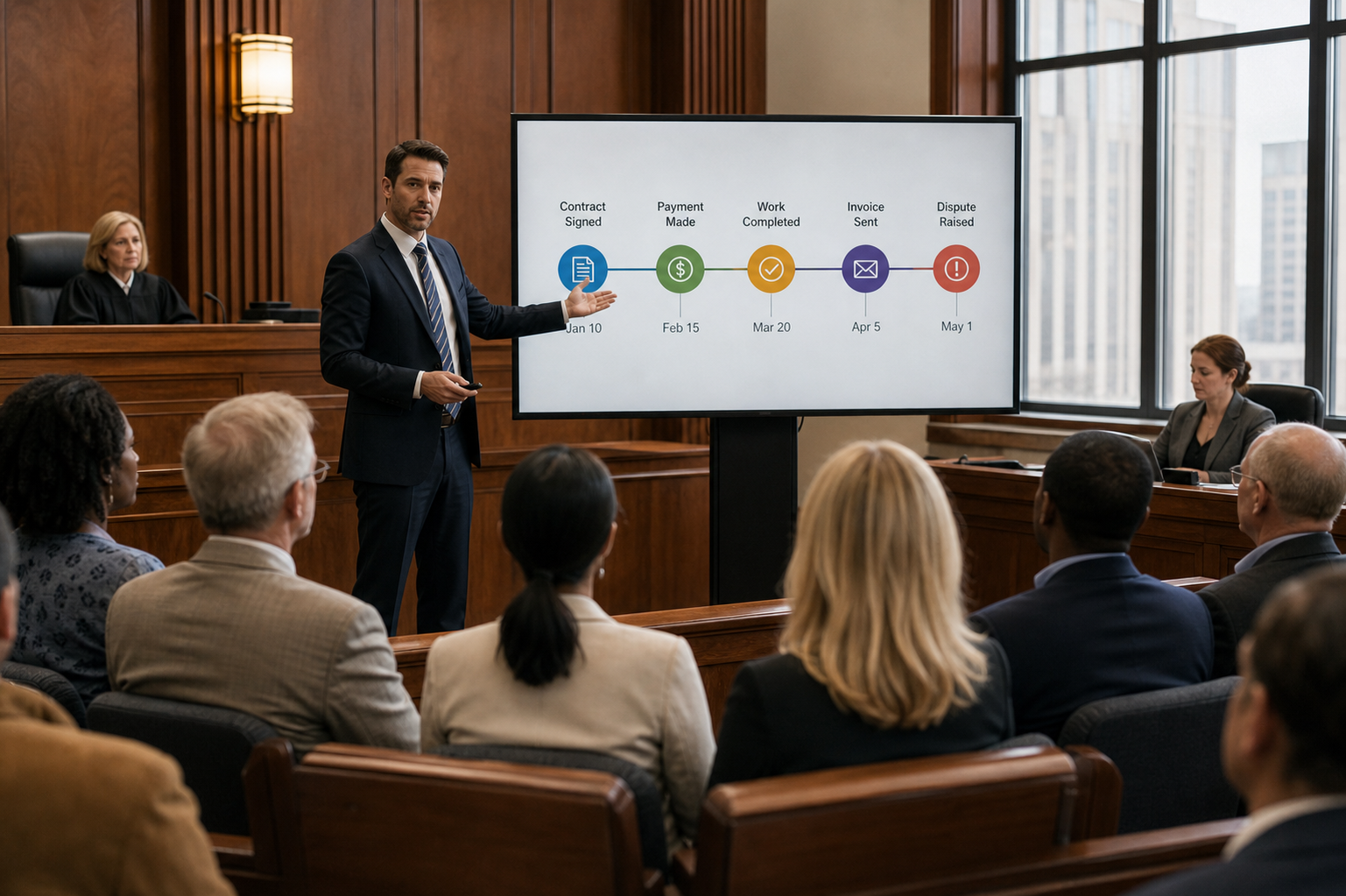
A well-designed timeline can clarify years of events in seconds.
An animation can explain a technical patent issue more effectively than fifteen minutes of testimony.
A scale graphic can instantly communicate the size of a manufacturing plant or the microscopic dimensions of a medical device.
A simple sequence diagram can eliminate confusion that would otherwise linger throughout deliberations.
Professional design isn't about aesthetics.
It's about reducing cognitive effort.
Every unnecessary second jurors spend figuring out your slide is one less second they're thinking about your argument.
The best lawyers simplify.
They don't complicate.
One habit I consistently see among outstanding trial lawyers is restraint.
They aren't trying to impress jurors with how much they know.
They're helping jurors understand why the case matters.
That often means using fewer words.
Fewer slides.
Stronger visuals.
Cleaner narratives.
Ironically, simplifying takes far more work than filling a slide with text.
As Blaise Pascal famously observed, "I would have written a shorter letter, but I did not have the time."
The same is true for courtroom presentations.
But I know PowerPoint...
I'm not suggesting lawyers shouldn't know PowerPoint.
Every trial attorney should.
Just as every lawyer should know enough about e-discovery, jury consulting, demonstrative evidence, and courtroom technology to collaborate intelligently.
Knowing how PowerPoint works is valuable.
Believing that makes someone a presentation expert is another matter entirely.
It's similar to owning Photoshop.
That doesn't make someone a professional illustrator.
Judges are noticing, too
The trend toward text-heavy, slide-filled presentations hasn't gone unnoticed.
Several federal judges recently criticized excessive PowerPoint use during complex litigation, observing that lawyers often force judges and jurors to read slides instead of listening to the advocate. One judge memorably compared slide overuse to kudzu, calling it "a sin" because it distracts from the presentation rather than strengthening it.
The problem isn't PowerPoint.
The problem is how it's used.
The real question
Whenever a lawyer tells me they're designing their own slides, I ask one question.
"If this were the single most important presentation of your client's life, who would you want designing it?"
Usually, they smile.
Because they already know the answer.
Related Persuadius Articles
If this topic interests you, you may also enjoy:
- The 12 Worst PowerPoint Mistakes Litigators Make
- Trial Graphics Dilemma: Why Can't I Make My Own Slides? (Says Lawyer)
- Do Professionally Designed PowerPoint Slides Get Better Results?
- 7 Bad Habits of Law Firm Litigators
- 5 PowerPoint Blunders: The Worst Litigators' Mistakes
- Why Reading Your Litigation PowerPoint Slides Hurts Jurors
- 12 Ways to Eliminate "But I Need Everything On That PowerPoint Slide"
- How Much Text on a PowerPoint Slide is Too Much?
- Don't Use PowerPoint as a Crutch in Trial or Anywhere
Need Help With Your Next Trial Presentation?
Whether you need a single opening statement, sophisticated animations, trial graphics, or a full courtroom presentation team, Persuadius helps litigators transform complicated evidence into persuasive visual stories.
Schedule a free 15-minute confidential consultation to discuss your upcoming case.
Or email us directly to learn how our jury consultants, litigation graphics team, and trial technicians can help strengthen your presentation before trial.

Leave a Comment